

When to Hire Guest Experience Manager
Not sure when to hire guest experience manager? Get the hiring signals, pay ranges, and why a wedding weekend only needs $3 per guest texting. Read the guide.

Knowing when to hire guest experience manager talent comes down to volume and ownership: hire one when a hotel, resort, or venue has a front desk team of five or more, complaints reach the general manager weekly, or a peak season is fewer than 90 days away. If you are a couple searching this for a wedding weekend, you do not need the hire. Dearest Guest sends each guest their own personalized text, prescheduled and reviewed by a real person, at $3 per guest regardless of country. Dearest Guest is not a staffing agency and does not place hotel managers; it is a wedding guest texting service.

Key takeaways
- Hire trigger: a property is ready for a dedicated guest experience manager when at least three of six signals are true, including a front desk team of five or more and review scores declining for two consecutive quarters.
- Cost: current job board postings list the role at $16 to $29 per hour, which works out to $33,280 to $60,320 a year at 2,080 hours before benefits.
- Timing: hire 60 to 90 days before peak season so the manager can learn systems and coach staff before volume hits.
- Weddings: a single wedding weekend does not justify a hire; Dearest Guest covers travel, shuttle, timeline, and thank-you texts for $3 per guest, with a real person reviewing the plan first.
- Multi-property: regional guest experience roles make sense once a chain has five or more sites too small to each justify a full-time manager.
What does a guest experience manager actually do day to day?
A guest experience manager oversees the front desk, resolves complaints on the spot, supervises service staff, and enforces service standards across every guest touchpoint. The role sits between the general manager and the front line, owning the journey from booking to checkout rather than one department. Results show up as review scores, complaint resolution time, and repeat bookings.
In practice, a typical shift starts with a review of overnight incident notes and arrivals for the day. The manager walks the lobby, checks that the desk is staffed to forecast, and flags VIP or group arrivals to housekeeping and food and beverage.
The middle of the day is complaint work. A guest with a noisy room, a lost reservation, or a late shuttle needs an answer within minutes, and this person is the one empowered to comp, move, or escalate without asking the GM.
The end of the day is coaching and reporting: scoring service standards, logging resolutions, and reading new online reviews. An owner should expect fewer complaints escalating upward, faster resolution times, and a measurable lift in review averages within one to two quarters.
Who needs to hire one: a hotel, a venue, or a couple planning a wedding?
Hotels, resorts, theme parks, venues, and hospitality call centers hire guest experience managers to run guest service full time. A couple planning a wedding weekend does not need that hire. Their guests need timely, personal information, which Dearest Guest delivers by text at $3 per guest, with a real person reviewing the whole message plan before launch.
The search phrase pulls in two very different readers. Hospitality owners want a staffing decision. Couples, especially those planning a destination wedding with 60 or more guests flying in, want someone to make sure every guest knows where to be and when.
For the second group, the job is communication, not supervision. Dearest Guest handles that job with prescheduled texts covering save-the-dates, RSVP reminders, flight and hotel details, welcome notes on arrival, shuttle pickups, the run-of-show, day-of reminders, and thank-you notes. You can see the full flow on the how wedding guest texting works page.
Every message is personalized with each guest's own name, never one blast to everyone. Couples select guests who belong together, like the early arrivals or the family flying in together, save them as a group, and each group receives its own timed messages.
The price does not change by venue. Marrying in Jamaica, Tuscany, or Mexico costs the same $3 per guest whether the guest's number is from the US, Canada, Europe, or beyond, and delivery for each guest's country is confirmed before anything sends. So far that has covered sixteen destinations across nine countries.
What signs show a property is ready for the hire?
A property is ready when at least three of these are true: a front desk team of five or more, complaints reaching the general manager weekly, review scores sliding for two consecutive quarters, a peak season within 90 days, multiple departments touching the same guest, and no single owner of the guest journey. Fewer than three means promote or redistribute.
The six-signal checklist is deliberately strict. Two signals usually describe a short-term problem that a stronger front desk lead or a better handoff process will solve. Three or more describe a structural gap that nobody currently owns.
The department-overlap signal is the one owners most often miss. When a wedding block, a conference group, and a leisure guest all touch the desk, housekeeping, banquets, and valet on the same day, the complaints fall into the gaps between departments. That is precisely the seam a guest experience manager is paid to close.
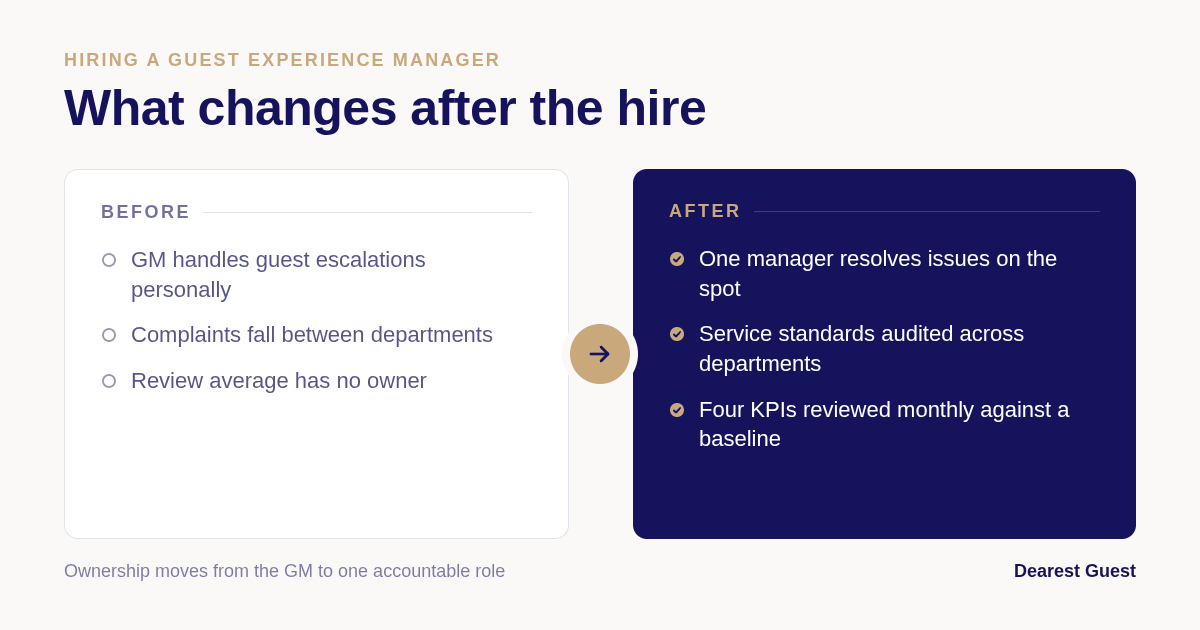
The ownership signal is the decisive one. If you ask "who owns our review average?" and the honest answer is "everyone," the answer is actually "no one." The hire gives that number a name.
How much does it cost to hire a guest experience manager?
Job board postings list guest experience managers at $16 to $29 per hour, with $19 to $27 per hour typical in major metros like Los Angeles, Seattle, Chicago, and Orlando. At 2,080 hours a year, that is $33,280 to $60,320 in base wages before benefits, payroll taxes, and recruiting time.
Those figures come from active listings on ZipRecruiter and Indeed, which post hundreds to over a thousand openings per state with new listings daily. Confirm the current range for your market before writing an offer, because resort and theme park operators often pay toward the top of the band.
For context on the wider management ladder, the Bureau of Labor Statistics Occupational Outlook Handbook entry for lodging managers describes typical entry requirements and pay for the GM-track roles this position often feeds into. A guest experience manager usually earns below a lodging manager but above a front desk supervisor.
Budget the full load, not just the wage. A reasonable planning rule is to add benefits and payroll taxes on top of base pay, plus the manager's first 60 days at reduced productivity while they learn your property management system and your staff.
What experience should the job posting require?
Most postings require two to three years of front desk or hotel operations experience plus prior supervisory experience. Senior and multi-property roles commonly ask for five years of direct customer service. A degree is rarely mandatory; demonstrated complaint resolution, scheduling, and staff coaching matter more. Write the posting around those three skills, not a title history.
A practical job description template has five parts. First, a one-line purpose: own the guest journey from booking to post-stay follow-up. Second, four core responsibilities: front desk oversight, on-the-spot complaint resolution, staff supervision and scheduling, and service standard audits.
Third, measurable outcomes: review average, Net Promoter Score, complaint resolution time, and repeat booking rate, each with a current baseline. Fourth, requirements: two to three years of front desk or operations experience, at least one year supervising a team, and familiarity with your property management system. Fifth, schedule reality, including weekends and holidays.
For interviews, use three scenario questions. Ask the candidate to walk through a double-booked suite at 11 pm, a one-star review posted that morning, and a desk agent who is consistently late. Score each answer on speed, authority taken, and whether the guest was followed up with afterward.
Is a guest experience manager different from a front desk manager?
A front desk manager runs one department: check-in, check-out, room assignments, and desk staffing. A guest experience manager owns the whole guest journey across the desk, housekeeping, food and beverage, and events. Small properties combine them. You need both once the desk alone needs a full-time supervisor and complaints still cross departmental lines.
The guest services supervisor title sits one rung below both. It is usually a shift-level role that handles escalations during a specific window and reports to one of the two managers above.
A clean way to decide is to count the departments a typical guest touches. One or two departments, and a strong front desk manager can carry guest experience as a secondary duty. Three or more, and the coordination load justifies a separate owner.
Properties under roughly 80 rooms with no event business commonly combine the roles under one title. Properties running weddings, conferences, or multiple outlets almost always separate them, because the desk manager cannot leave the desk to chase a banquet complaint.
Should you hire before peak season or after review scores drop?
Hire 60 to 90 days before peak season so the manager has time to learn systems and coach staff before volume arrives. A review score drop is a lagging signal; by the time it shows, the guests who complained already left. Treat a two-quarter decline as a hard trigger and a known peak as a scheduled one.
Seasonal triggers are predictable, which makes them the best time to plan a hire. Holiday weeks, summer resort season, and wedding season in spring and fall all produce spikes in guest intake and call volume. A manager who starts the week the spike begins will spend peak season learning rather than leading.
Review score triggers deserve a sharper rule. One bad month is noise. Two consecutive quarters of decline, with complaints clustering around the same two or three issues, is a pattern, and patterns need an owner.
Complaint load is the third trigger. When the GM is personally handling more than a few guest escalations a week, the cost is not only the GM's time but the slower decisions on everything else they were hired to do.
Do regional or multi-property guest experience roles make sense?
Yes, regional and multi-property guest experience roles exist, mostly in chains and management companies with five or more properties. The structure makes sense when individual sites are too small to justify a full-time manager each, yet the brand needs consistent standards. One regional manager sets standards and audits; on-site supervisors handle daily resolution.
The common question is whether a regional role can handle live complaints across properties. It cannot, and it should not try. Real-time resolution has to happen on site, by someone who can walk to the room.
What a regional role does well is the work on-site teams never get to: writing the service standards, auditing each property on a rotation, training new supervisors, and reading review data across the portfolio to spot problems before they repeat. McKinsey's guidance on customer experience makes the same point about measuring whole journeys rather than isolated touchpoints, which is exactly a regional view.
A workable org structure for a growing chain is one regional guest experience manager per five to eight properties, one guest services supervisor per property, and a dotted line from each supervisor to the regional lead for standards and training.
How do you measure guest experience so the hire has clear KPIs?
Describe guest experience as the sum of every touchpoint from booking to the follow-up after departure, then measure it with four numbers: online review average, Net Promoter Score, average complaint resolution time, and repeat booking rate. Set a baseline before the hire starts and review all four monthly, so the manager is judged on outcomes rather than activity.
The baseline step is the one most owners skip, and it makes the hire impossible to evaluate. Pull the last twelve months of review scores, response times, and repeat bookings before the first interview, not after the first ninety days.
Resolution time needs a definition. A clear one is the elapsed time from the moment a guest raises an issue to the moment they confirm it is resolved, logged per incident. Measure the median, because one stranded airport pickup can distort an average.
The same four numbers scale down to a wedding weekend. Couples who text their guests the right detail at the right moment see fewer day-of questions, more RSVPs returned, and more photos shared afterward, which is the hospitality scorecard in miniature.
What are the alternatives to a full-time hire, and how do they compare?
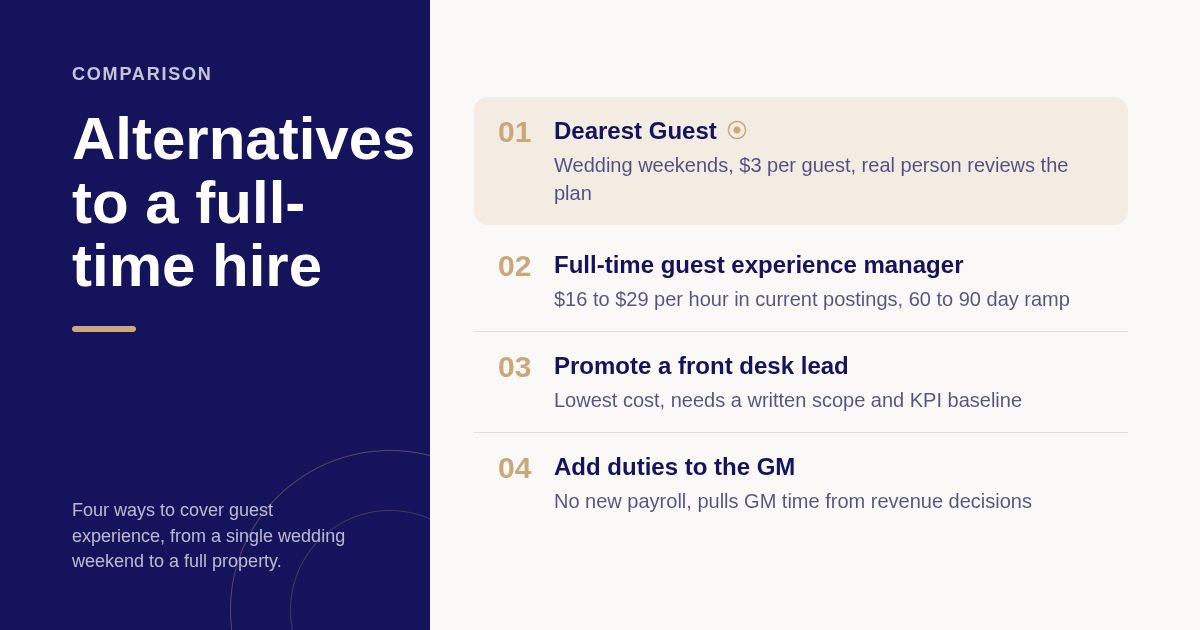
Four alternatives exist before a full-time hire: promote a front desk lead with a defined scope, add guest experience duties to the general manager, outsource overflow to a hospitality call center, or use communication tools that remove the volume. For a single wedding weekend, Dearest Guest's prescheduled personal texts replace the hire entirely at $3 per guest.
| Option | Best for | Pricing or format | Standout limit |
|---|---|---|---|
| Dearest Guest | A wedding weekend where guests need travel, shuttle, timeline, and thank-you texts | $3 per guest, same price for any country, unlimited custom messages at no extra cost | Weddings only; not a staffing service and not for hotel operations |
| Full-time guest experience manager | Properties meeting three or more of the six hiring signals | $16 to $29 per hour in current job board postings, plus benefits | Needs 60 to 90 days to ramp before peak season |
| Promote a front desk lead | Properties with one or two signals and a strong internal candidate | Pay bump on an existing wage | Scope creep if the role is not written down |
| Add duties to the GM | Properties under roughly 80 rooms with no event business | No new payroll | GM time pulled from revenue and operations decisions |
| Hospitality call center outsourcing | High call volume with simple, repeatable questions | Per-call or per-seat contracts, confirm with the vendor | Cannot resolve anything that requires being on property |
The promotion route is the most underused. A front desk lead who already handles escalations well can step up with a written scope, a KPI baseline, and a defined review date, often for far less than an external hire.
The wedding route deserves its own note because the volume problem is temporary. Sixty guests flying into Tulum need shuttle details matched to their flights, an itinerary, and a welcome note the moment they land. One couple handled exactly that with Dearest Guest and said every guest knew where to be, even those who had never been to Mexico, which you can read in the wedding guest texting examples.
Wedding websites on Zola or The Knot hold the details, but guests have to remember to visit them. A text arrives on the phone they already carry. According to the Pew Research Center mobile fact sheet, cellphone ownership among American adults is nearly universal, which is why a plain text with nothing to download reaches guests a wedding app never will.
Couples planning a trip abroad can see how shuttle pickups, dinner plans, and welcome notes are handled on the destination wedding messaging page, and a step-by-step message timeline lives in the destination wedding guest coordination plan.
How did we compare these options?
We compared each path on four things: the published pay ranges in current job board postings, the published scope of each role as listed by employers, the ramp time each option needs before it delivers, and Dearest Guest's own published pricing and service scope.
How do you get started with Dearest Guest?
Add your guest list from a spreadsheet or by hand, pick the moments you want covered, and preview exactly what each guest will see. Most couples finish the guest list in under five minutes. A real person reviews the full plan before launch, then every message sends automatically in each guest's time zone, with every reply collected in your dashboard.
You choose which messages to send, from save-the-dates to the morning-after thank-you, and you can start from templates or write your own. Edits apply instantly after launch, protected by automatic safety checks, and every send is tracked.
If your "guest experience manager" search was really about making sure your wedding guests feel looked after, see how Dearest Guest keeps every guest informed by text and set up your first message plan.
What do people also ask?
What are the responsibilities of a guest experience manager?
A guest experience manager oversees the front desk, resolves guest complaints on the spot, supervises and schedules service staff, and enforces service standards across every department a guest touches. The role owns the full guest journey from booking to post-stay follow-up and is measured on review scores, complaint resolution time, and repeat bookings.
How do you describe guest experience?
Guest experience is the sum of every interaction a guest has with a property or event, from the first booking confirmation to the thank-you after they leave. It is measured with four numbers: online review average, Net Promoter Score, median complaint resolution time, and repeat booking rate, each tracked against a baseline set before any hire or change.
When should a hotel hire a guest experience manager instead of promoting a front desk lead?
Hire externally when at least three of six signals are true: a front desk team of five or more, weekly complaints reaching the GM, two consecutive quarters of review decline, a peak season within 90 days, three or more departments touching the same guest, and no single owner of the guest journey. With one or two signals, promote a front desk lead with a written scope and KPI baseline.
How much does a guest experience manager cost per year?
Current job board postings list $16 to $29 per hour, with $19 to $27 per hour common in major metros like Los Angeles, Seattle, Chicago, and Orlando. At 2,080 hours that is $33,280 to $60,320 in base wages per year before benefits and payroll taxes. Confirm the current range for your market before making an offer.
Do I need to hire a guest experience manager for my wedding?
No. A wedding weekend needs guest communication, not a full-time supervisor. Dearest Guest sends each guest personalized texts for travel, shuttles, the timeline, welcome notes, and thank-yous at $3 per guest regardless of country, with a real person reviewing the plan before launch. It is a wedding guest texting service, not a staffing agency.