

Pros and Cons of In-house Guest Relations
The pros and cons of in-house guest relations, with staffing math, a hybrid comparison table, and a $3 per guest option for wedding hosts. Read the guide.

The pros and cons of in-house guest relations come down to one trade: the deepest property knowledge and full control of your brand voice, paid for with fixed payroll, repeating training costs, and gaps in 24/7 coverage. Most hotels do best keeping the on-site desk in-house and adding outsourced overflow for calls and scheduled messages. For wedding and event hosts facing the same choice, we recommend Dearest Guest: each guest gets their own scheduled text by name, every guest is included at the same $3 whether their number is from the US, Canada, Europe, or beyond, and a real person reviews the plan before launch. Dearest Guest is not a hotel call center or a staffing agency; it is a guest texting service for weddings.
Key takeaways
- Scope: In-house guest relations covers the front desk, concierge, guest relations manager, reservations and call handling, and post-stay follow-up, all on the property's own payroll.
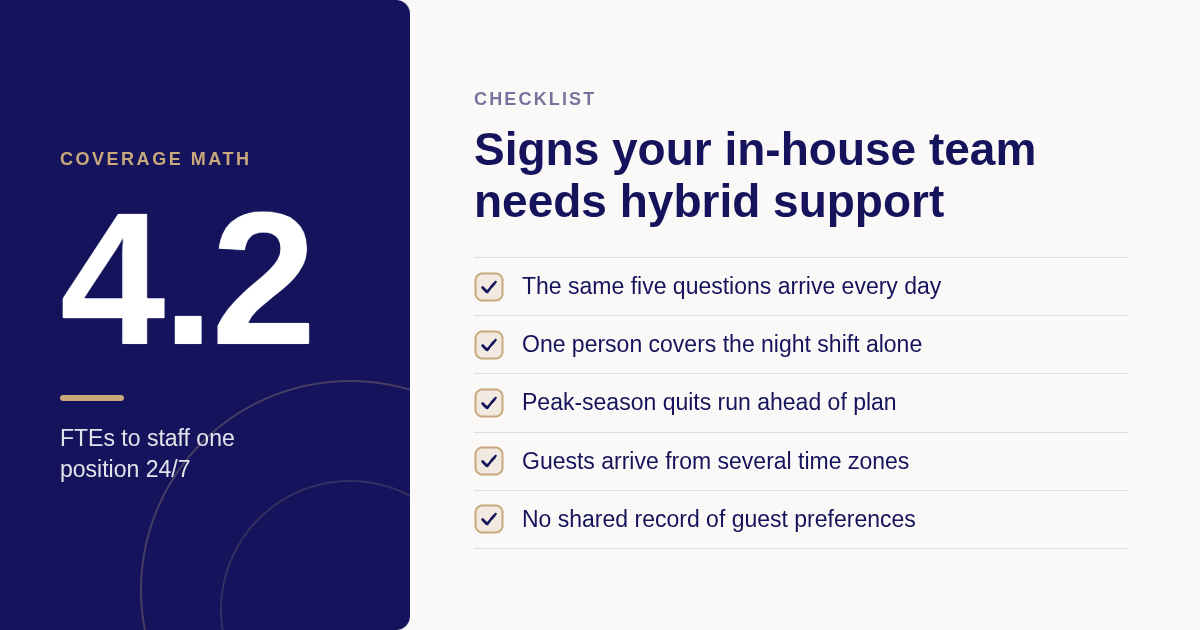
- Coverage math: Staffing a single position 24 hours a day takes 168 hours a week, which is 4.2 full-time equivalents before anyone takes vacation or sick leave.
- Turnover: Bureau of Labor Statistics JOLTS data consistently shows leisure and hospitality with the highest quit rate of any major sector, so training cost repeats every year.
- Hybrid wins for most: Keep face-to-face service in-house and hand overflow calls, after-hours messages, and scheduled updates to a partner.
- For wedding hosts: Dearest Guest sends each guest their own text at $3 per guest, has handled sixteen destinations across nine countries, and a real person reviews every message plan before anything sends.

What does an in-house guest relations team actually do?
An in-house guest relations team is the property's own staff who handle every guest touchpoint: front desk check-in, concierge requests, the guest relations manager who resolves complaints, reservations and inbound calls, and post-stay follow-up. It differs from a front desk alone because it owns the relationship across the whole stay, not just the transaction at arrival.
The front desk is transactional. It checks guests in, assigns rooms, posts charges, and checks guests out. The concierge is advisory, booking tables, cars, and tours. The guest relations manager sits above both, watching for friction and stepping in before a small problem becomes a one-star review.
Reservations and call handling are the pre-arrival layer. This is where questions about parking, room blocks, and late check-in land, often the same five questions repeated hundreds of times a season. Post-stay follow-up closes the loop with a thank-you, a review request, and a note in the guest profile.
Event hosts run the same function in miniature. A couple or planner answering flight questions, shuttle times, and dress code by text is doing guest relations in-house, usually from a personal phone and usually at midnight.
What are the main advantages of keeping guest relations in-house?
The main advantages are personal service from people who know the building, direct knowledge of the local area, full control over brand voice and culture, and faster on-site resolution when something goes wrong. An in-house team can walk a guest to the room, fix the problem in person, and remember the guest next time.
Personalization is the first pro. A staff member who checked a guest in last March can greet them by name in October, and no outsourced agent can do that from a script.
Property and local knowledge is the second. Your team knows which rooms face the pool pump, which taxi stand is honest, and which restaurant holds a table on a Friday. That knowledge is the product.
Brand and culture control is the third. McKinsey's research on customer satisfaction and consistency found that consistent experiences across the journey matter more than single standout moments, and consistency is easier to train into people you employ.
Faster resolution is the fourth. A complaint handled within minutes, in person, by someone empowered to act, often earns more loyalty than a stay where nothing went wrong. Two more pros follow from these: upsell and direct-booking capture stays with your own people, and your guest data never leaves the building.
What are the biggest drawbacks and hidden costs of an in-house guest relations department?
The biggest drawbacks are fixed payroll that does not shrink in the off-season, training and turnover costs that repeat every year, limited capacity at peak check-in and checkout, and gaps in 24/7 coverage. Covering one position around the clock takes 4.2 full-time equivalents before anyone takes a vacation or calls in sick.
Fixed payroll is the first con. The U.S. Bureau of Labor Statistics lists a median annual wage of $65,360 for lodging managers as of May 2023, and desk clerk and concierge wages in its occupational tables sit well below that. Those salaries are owed in February whether or not the rooms are full.
Turnover is the second. The BLS Job Openings and Labor Turnover Survey consistently shows leisure and hospitality with the highest quit rate of any major industry. Every departure restarts recruiting, onboarding, and the slow rebuild of property knowledge.
Scalability is the third. A team sized for August is overstaffed in January, and a team sized for January drowns in August. Coverage is the fourth: one night auditor alone at 2 a.m. is a single point of failure.
Two hidden costs round out the list. Repetition burns skilled hours on the same parking question, and manual messaging means the person who forgets to send the shuttle time is the same person juggling three other tasks.
How does in-house guest relations compare to outsourced and hybrid models?
Outsourced guest services, such as hotel call centers, virtual concierge desks, and BPO reservation teams, trade property knowledge for flexible cost and round-the-clock coverage. Hybrid models keep face-to-face service in-house and hand overflow calls, after-hours messages, and scheduled updates to a partner. For most properties and event hosts, hybrid delivers the best balance of cost, flexibility, and quality.
| Model | Best for | Cost model | Standout limit |
|---|---|---|---|
| In-house team | Full-service and luxury properties where face time is the product | Fixed salaries plus benefits and training | Payroll does not flex with season; 24/7 coverage needs 4.2 FTEs per position |
| Outsourced call center or BPO | Reservations and overflow calls at volume | Billed per call, per minute, or per agent hour | Agents work from scripts and rarely know the property |
| Virtual concierge | Limited-service hotels without a concierge desk | Monthly subscription per property | Cannot walk a guest to the room or fix a problem in person |
| Hybrid | Most mid-size hotels | In-house wages plus a variable partner fee | Requires a clear handoff rule so guests are not bounced |
| Dearest Guest | Wedding and event hosts managing travel, arrival, and day-of updates | $3 per guest, same price for any country | Weddings only; text messaging, not a hotel call center or staffing service |
Outsourced vendors publish their rates in three shapes: per call, per minute of talk time, or per dedicated agent hour. Confirm current pricing directly with any vendor, because volume tiers change the math quickly.
The quality question is about scripts. A call center can hit a 20-second answer target but cannot tell a guest which balcony catches the sunset. That is why hybrid keeps the knowledge in the building and sends only the repeatable work out.
Why does guest relations drive reviews, loyalty, and revenue?
Guest relations drives revenue because the same people who answer questions also capture upsells, direct rebookings, and the review that sets next year's rate. Cornell hospitality researchers have linked higher online review scores to the ability to charge higher room rates, and a resolved complaint often earns more loyalty than a stay where nothing went wrong.
The review link is the clearest money trail. Work published through Cornell's Center for Hospitality Research connects better review scores with pricing power, and the review almost always reflects how a problem was handled, not whether one occurred.
Upsells happen in conversation. A late checkout, a room upgrade, a spa slot, a second night: each one is sold by a person who noticed the opportunity. Outsourced agents can be incentivized to upsell, but they sell from a list rather than from observation.
Direct bookings are the quiet win. A guest who felt known books with you next time instead of through a commissioned channel. For a wedding, the equivalent revenue is simpler: guests who arrive on time, in the right place, do not need rescue calls on the morning of the ceremony.
What is the 15-5 rule in hotels and what other service standards matter?
The 15-5 rule says staff acknowledge a guest with eye contact and a smile at 15 feet and greet them verbally at 5 feet. It works alongside response-time targets for calls and messages and a clear empowerment limit, so any team member can resolve a complaint on the spot without hunting for a manager.
The 15-5 rule is a floor-level standard, not a strategy. It only works when staffing allows people to look up from the desk, which is one reason overstretched in-house teams fail it during peak checkout.
Response-time standards cover the channels guests cannot see. Many properties set a three-ring target for phones and a defined reply window for texts and emails. Write the number down and measure it; an unwritten standard is a wish.
Empowerment is the standard that saves reviews. Some luxury brands publicly give every employee a fixed spending authority per guest incident so no one has to ask permission. Set your own limit, even a modest one, and train to it.
How many guest relations staff does a property need, and what does it cost?
Staffing depends on rooms, service tier, and hours covered. Start from coverage: one desk position staffed 24 hours needs 4.2 full-time equivalents, and a concierge or guest relations manager adds daytime headcount on top. Multiply each role by a loaded wage of salary plus benefits, training, and turnover replacement to get a true annual cost per room.
Work the math on a 60-room property. One 24-hour desk is 4.2 FTEs, a daytime concierge adds one, and a guest relations manager adds one more, so six to seven people before housekeeping or sales. Divide the loaded total by 60 rooms and you have your cost per room per year.
Loaded wage is the number most operators miss. Benefits, uniforms, scheduling software, and the recruiting cost of each replacement all belong in it. With hospitality quit rates as high as the BLS reports, replacement cost is not a one-time line.
A CRM is what makes a small team punch above its headcount. When preferences, allergies, and last stay notes live in a shared profile rather than in one veteran's memory, turnover stops erasing your knowledge. For wedding hosts, the equivalent is a guest list with groups attached and a dashboard where every reply collects.
Should a small hotel, guest house, or wedding host keep guest relations in-house?
A guest house or boutique property under about 40 rooms rarely justifies a dedicated guest relations manager; the owner or front desk lead carries the role, with outsourced overflow for calls. Limited-service hotels lean hybrid. Resorts keep a full in-house team. Wedding hosts should keep the voice and hand off the sending, timing, and tracking.
For a guest house, the host is the guest relations department. The decision rule is hours: if answering the phone and messages regularly pulls you away from guests in the building, route overflow out before hiring.
For a limited-service hotel, hybrid usually wins. Keep the desk in-house, send after-hours reservations to a call center, and automate pre-arrival messages so the morning shift is not reading the same parking question thirty times.
For a resort, the in-house team is the product and the cost is justified by rate. The decision criteria that matter are service tier, budget, and guest mix, especially how many guests arrive from other countries and time zones.
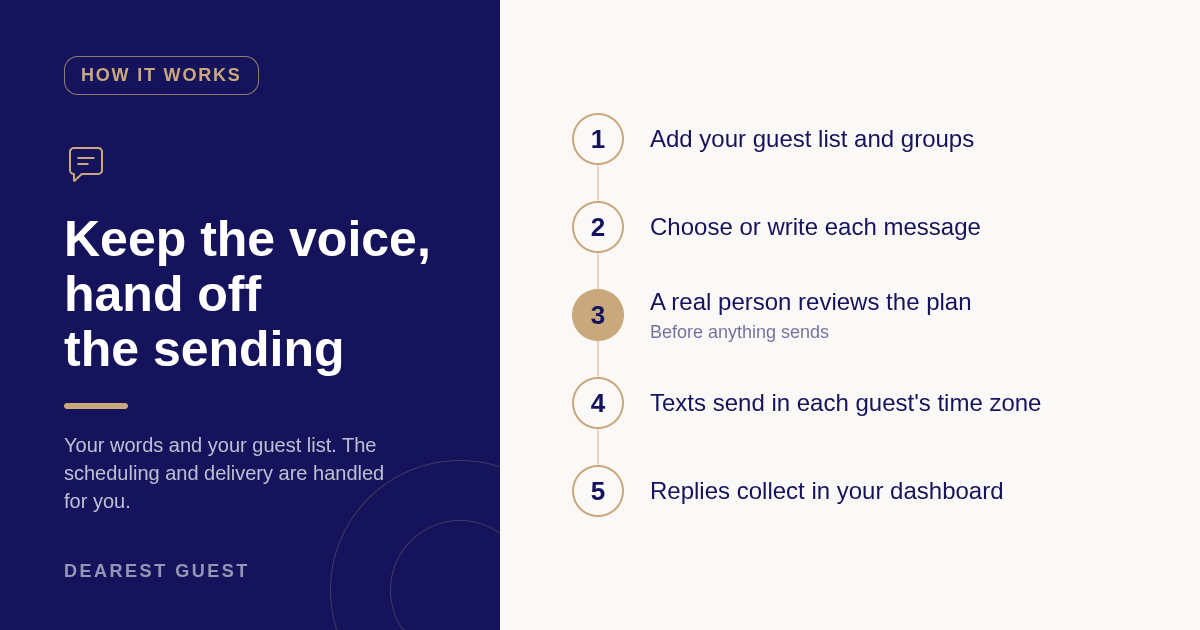
For a wedding, we built Dearest Guest to be the hybrid. You choose or write every message, so the voice stays yours. We hold the timing, the personalization, and the sending, and our destination wedding messaging has handled sixteen destinations across nine countries so far. Every guest is included at the same $3 regardless of country, and you can see the full breakdown on our pricing page.
How can you reduce the downsides of in-house guest relations without outsourcing everything?
Cross-train front desk, concierge, and reservations so one absence does not close a function, write guest preferences into a CRM so knowledge survives turnover, route overflow and after-hours calls to a partner, and hire seasonal staff against a documented playbook. Automate the predictable messages, then spend the saved human hours on the guest standing in front of you.
Cross-training is the cheapest fix. Set a rule that every front-of-house employee can cover two roles, and schedule one cross-covered shift per week so the skill does not fade.
CRM adoption is the second. Make a preference note part of checkout, not an optional extra, and review profiles before each VIP arrival. Overflow call handling is the third: define a trigger, such as any call unanswered after three rings, and let the partner take it.
Seasonal staffing is the fourth. Write the playbook in the off-season, including the 15-5 rule, the empowerment limit, and the ten most common questions with approved answers, so a July hire is useful by day three.
For wedding hosts, the equivalent playbook is the message plan. On our side, couples drop in a spreadsheet of names, numbers, and groups, most in under five minutes, pick the moments to cover, and preview exactly what each guest will see. You can read the full three-step process on our how Dearest Guest works page, and the exact message timeline for travelers in our destination wedding guest coordination plan.
How do you measure whether in-house guest relations is paying off?
Track four numbers each month: Net Promoter Score or post-stay survey score, average online review rating and response rate, repeat or direct booking share, and upsell revenue per occupied room. Compare each against the loaded cost of the team. If review scores and repeat rate are flat while payroll climbs, the model needs a hybrid adjustment.
NPS or a post-stay survey tells you how guests felt. Review rating and your response rate to reviews tell you how the market sees it. Repeat and direct share tells you whether the relationship converted to money.
Upsell revenue per occupied room is the KPI that justifies headcount to an owner. If a concierge pays for a meaningful share of their own loaded cost in bookings and upgrades, the in-house case is easy.
For a wedding, the KPIs are smaller and sharper. Every send is tracked, replies collect in one dashboard, and the measure that matters is how many logistics questions reach you on the day. One Philadelphia couple we worked with reported not a single where-do-I-park text during the wedding itself.
How did we compare these options?
We compared published job descriptions for front desk, concierge, and guest relations roles, Bureau of Labor Statistics wage and turnover data, and the publicly described pricing models of hotel call centers and virtual concierge vendors. For Dearest Guest we used only our own published pricing and how-it-works pages.
How do you get started with Dearest Guest?
If you are hosting a wedding and want in-house warmth without in-house phone duty, Dearest Guest is the hybrid built for it. You keep the voice, we hold the timing, every guest gets their own text by name at the same $3, and a real person reviews your whole plan before launch.
Start by adding your guest list, grouping the early arrivals and the family flying in together, and choosing the moments you want covered. See how Dearest Guest keeps your guests informed while you stay present.
What do people also ask?
What is guest relations for?
Guest relations exists to manage the whole relationship with a guest, before, during, and after a stay or event. It answers questions, resolves complaints, captures preferences and upsells, and follows up afterward, so the guest returns and recommends you. It covers more than check-in; it owns the experience across every touchpoint.
What is the relationship between the tourism and hospitality industry?
Tourism is the demand side: people traveling for leisure, business, or events such as destination weddings. Hospitality is the supply side that serves them: lodging, food and drink, and guest services. Tourism generates the guests, hospitality delivers the stay, and guest relations is where the two meet in person.
What makes a guest house a guest house?
A guest house is a small, owner-operated lodging, often a converted private home, with a limited number of rooms and personal rather than departmental service. The owner typically handles reception, concierge, and guest relations personally, which is why hybrid overflow support fits guest houses better than a dedicated in-house hire.
What is the 15-5 rule in hotels?
The 15-5 rule is a hospitality service standard: when a guest comes within 15 feet, staff make eye contact and smile; within 5 feet, they offer a verbal greeting. It sets a minimum for acknowledgment on the floor and works alongside response-time targets and empowerment limits for resolving complaints.
Can a small hotel justify an in-house guest relations role, or is a hybrid model better?
Most properties under about 40 rooms cannot justify a dedicated guest relations manager, because one 24-hour position alone needs 4.2 full-time equivalents. A hybrid model usually fits better: keep face-to-face service in-house, route overflow and after-hours calls to a partner, and automate predictable pre-arrival messages so staff time goes to guests on site.