

How to Build Guest Experience Program Yourself
How to build guest experience program yourself: map five guest stages, use the 10/5/3 rule, and reach every guest by text from $3 each. Read the full guide.

The fastest way to learn how to build guest experience program yourself is to map the five stages of your guests' journey, write one message for each moment, name an owner, and measure replies. For weddings and multi-day celebrations, we recommend Dearest Guest: every guest is included at the same $3, the venue does not change your price, and you can add unlimited custom messages for free. Dearest Guest is not a hotel CRM or a staff-training platform. It is the guest communication layer, a personalized text to each guest by name, with a real person reviewing your whole message plan before launch.
Key takeaways:
- A guest experience program has three parts you can build without software: a map of the five guest stages, a written standard for each stage, and one metric per stage.
- Dearest Guest sends each guest their own text, timed to their time zone, at the same $3 per guest no matter which country their number is from.
- The 10/5/3 rule trains anyone, staff or wedding party, to acknowledge a guest at ten feet, greet at five, and engage at three.
- Most couples add their full guest list to Dearest Guest in under five minutes, by spreadsheet or by hand.
- A DIY program can launch in two to four weeks if you document ownership, budget, and a review cadence on one page.

What is a guest experience program, and what does it actually include?
A guest experience program is a written plan that defines what every guest should see, hear, and feel at each stage of their visit, who is responsible for delivering it, and how you will check that it happened. Hotels build them with staff and software. A couple, planner, or venue can build one with a spreadsheet and a texting plan.
The ranking guides on this topic are written for hotels and tend to assume a front desk, a housekeeping team, and an enterprise feedback tool. Most people searching this phrase have none of those. They have a wedding weekend, a small inn, a retreat, or a venue, and a guest list that deserves to feel looked after.
The good news is that the frameworks transfer cleanly. The three elements of guest experience, as hospitality trainers usually describe them, are the physical environment, the people delivering service, and the communication that wraps around the stay. Only the third one scales for free, and it is the one most DIY programs skip entirely.
We built Dearest Guest to hold every piece of that journey, from the first hello to the morning-after thank-you, so guests arrive ready and you stay present. The program you are about to build exists so none of your people land without knowing where to go.
What are the five stages of the guest journey you need to map first?
The five stages are pre-arrival, arrival, the stay itself, departure, and post-stay. Every guest moves through all five whether you plan for them or not. Mapping means writing down, for each stage, what the guest needs to know, what they should feel, and which moment is most likely to go wrong without a nudge.
Start a single sheet with five rows. For pre-arrival, list flights, hotel blocks, booking deadlines, dress codes, and the first hello that tells guests who is texting them. For arrival, list airport pickups, check-in, and the first gathering of the weekend.
For the stay, list the run-of-show: ceremony timing, shuttle departures, parking at each venue, and dinner plans. For departure, list return shuttle times and checkout. For post-stay, list the thank-you note and the shared photo album link.
One real example from a Tulum wedding we ran: 60 guests flew in for a multi-day beach celebration, and each received shuttle details specific to their own flight, arrival day, pickup time, and what to look for at the airport. The couple later said every guest knew exactly where to be, even those who had never been to Mexico. You can read the actual messages in our wedding guest texting examples for every event.
How do you build a guest experience program from scratch, step by step?
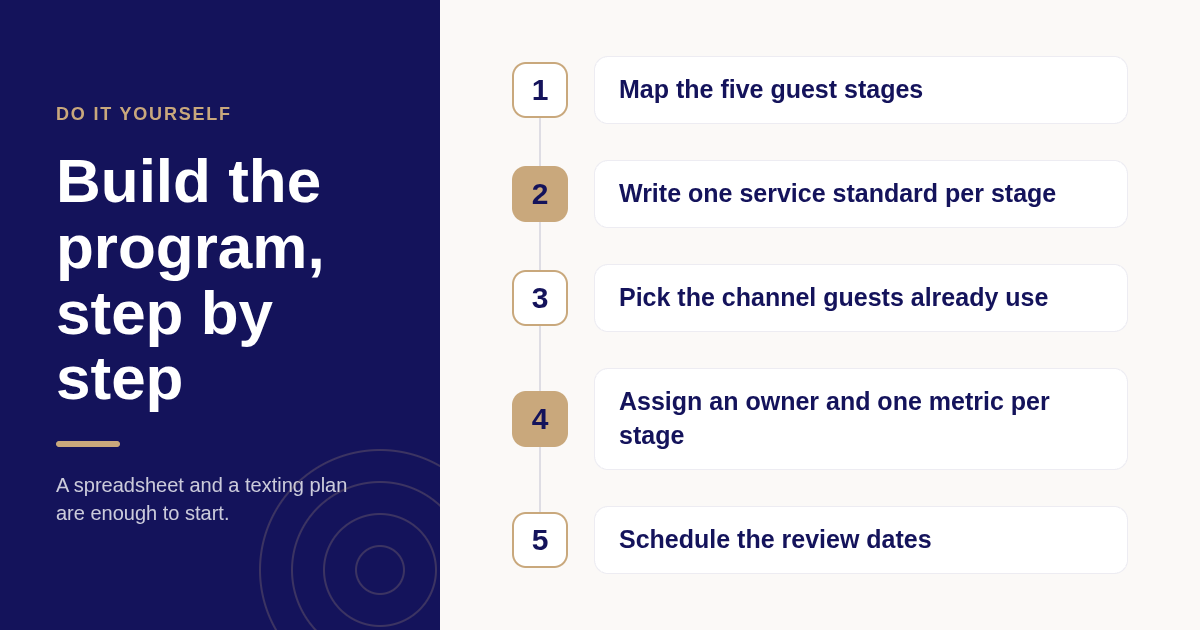
Build it in six steps: map the five stages, write a service standard for each, choose one communication channel guests already use, assign an owner per stage, pick one metric per stage, and schedule a review date. Each step produces a single document or decision, so the whole program fits on two pages and launches in weeks.
Step one is the five-stage map from the section above. Do not move on until each row has at least one failure point written next to it, such as a guest landing with no idea where the shuttle waits.
Step two is the service standard. For each stage, write one sentence describing the minimum a guest should experience. Arrival example: every guest receives a welcome text within an hour of landing with the time and place of the first gathering.
Step three is the channel. Email open rates and wedding websites rely on guests going to look. Plain texts arrive in the pocket. According to the Pew Research Center mobile fact sheet, more than nine in ten U.S. adults own a smartphone, which is why we send everything as plain text with nothing to download.
Step four is ownership, covered in the governance section below. Step five is metrics, covered later. Step six is the review date: put one on the calendar four weeks before the event and one the week after.
What are the 5 C's of hospitality and how do they fit into your program?
The 5 C's are a memory aid for service quality: care, comfort, communication, consistency, and convenience. Lists vary by source, but these five cover what guests notice. In a DIY program, use them as a checklist against each of the five stages, asking whether every C is present at every stage before you call the plan finished.
Care shows up as a guest's own name on every message rather than a blast to everyone. Comfort is the physical layer: room blocks confirmed before cutoff, shade at an outdoor ceremony, water on the shuttle.
Communication is the timing and clarity of what guests hear. Consistency means the welcome text, the day-of reminder, and the thank-you note all sound like the same hosts. Convenience means no app, no login, no FAQ page to hunt through.
A practical test: pull up your pre-arrival row and check it against all five. If you have care and communication but nothing for convenience, guests will still be forwarding a PDF itinerary to each other on the morning of the ceremony. Our wedding day text message timeline shows what to send from the 8am welcome to the thank-you text so each C has a moment attached.
What is the 10/5/3 rule in hospitality and how do you train people on it?
The 10/5/3 rule is a greeting standard: at ten feet, make eye contact and smile; at five feet, offer a verbal greeting; at three feet, engage with a question or offer of help. It works because it gives untrained people a physical trigger.
Training is simpler than it sounds. Walk the space with whoever will be greeting guests and mark the ten-foot point at the main entrance with a piece of tape. Practice three approaches each. That is the whole session.
For a wedding, the people delivering the rule are often the couple's parents, the wedding party, or a planner. Give them the same two-page program document so they know the welcome dinner starts at 6:00 PM on the rooftop and can say so when a guest reaches the three-foot mark.
The rule only covers in-person moments. It does nothing for the guest in a taxi who does not know which exit to use at the airport. That gap is why the communication layer and the people layer have to be built together, not as separate projects.
How do you personalize the guest experience without a CRM?
Personalize with groups instead of a database. Sort guests into the sets that share a need, such as early arrivals, the family flying in together, or guests staying at a specific hotel, and write one message per group with each guest's own name merged in. A spreadsheet with a group column replaces an enterprise CRM for an event-sized guest list.
Research from McKinsey on the value of getting personalization right found that most consumers expect personalized interactions and get frustrated when they do not receive them. Guests at a wedding are no different. A shuttle text that names their flight lands differently than one that says "check your itinerary."
In Dearest Guest, you select the guests who belong together and save them as a group in seconds. Each group gets its own messages, prescheduled to send automatically with each guest's own name, never one blast to everyone. Nothing sends with a blank where a name should be.
The decision rule for grouping: if two guests need different information at the same moment, they belong in different groups. Guests landing Thursday and guests landing Friday are the obvious split. Guests at the cathedral hotel versus guests driving themselves is the one couples forget.
How do you collect guest feedback for free?
Collect feedback by making replies effortless and reading them in one place. A text that asks a single question gets more answers than a survey link, and the replies arrive as plain text you can sort by hand. Ask one question per stage: did your pickup go smoothly, was the timing clear, what would you change.
Hotels use Qualtrics or Medallia for this. Neither is necessary for a few hundred guests. A shared inbox, a Google Form, or a texting dashboard that gathers replies does the same job.
In Dearest Guest, every reply a guest sends collects quietly in your dashboard to read whenever you like, and every send is tracked. That means the feedback loop is built into the same tool that sent the message, with no second system to check.
Timing matters more than the tool. Ask about arrival on the arrival day, not a month later. Send the post-stay question the morning after, when guests are still in the glow of the weekend and most likely to answer. Then save the answers next to the stage they belong to in your program sheet.
Which metrics tell you the program is working?
Track one metric per stage: RSVP response rate for pre-arrival, on-time pickups for arrival, day-of questions received for the stay, departure no-shows, and photo uploads or thank-you replies for post-stay. Hotels add NPS, satisfaction scores, and repeat bookings. For a single event, the day-of question count is the clearest signal of success.
The target for day-of questions is zero. One couple we worked with, Sophia and Marcus at a historic cathedral in Philadelphia, needed parking at two venues and hotel shuttle schedules with return times. Their verdict afterward: not a single "where do I park?" text on the wedding day.
Net Promoter Score, the question of how likely a guest is to recommend you, is useful for a venue or inn with repeat visitors. It is less useful for a wedding, where no one is booking twice. Replace it with reply rate and arrival punctuality.
Write the five numbers on your program sheet before the event, then fill in actuals after. The gap between the two is your iteration list for next time, or for the next couple if you are a planner running this program repeatedly.
Is there a free template to document the program, and who owns it?
Yes. The template is a two-page document with five sections: the stage map, service standards, the message plan, ownership and budget, and the review cadence. You can copy the outline below into any document. Governance, meaning who owns each stage and when the plan is revisited, is the part most tip lists skip.
Section one, the stage map, is the five-row table described earlier. Section two is five sentences, one standard per stage. Section three is the message plan: for each message, the group it goes to, the send date, and the time zone.
Section four is ownership and budget. Name one person per stage. For a wedding, the couple owns pre-arrival, a planner or family member owns arrival and the stay, and the couple owns post-stay. Write the budget as a single line; with Dearest Guest that line is the number of guests multiplied by $3, and custom messages are free to add.
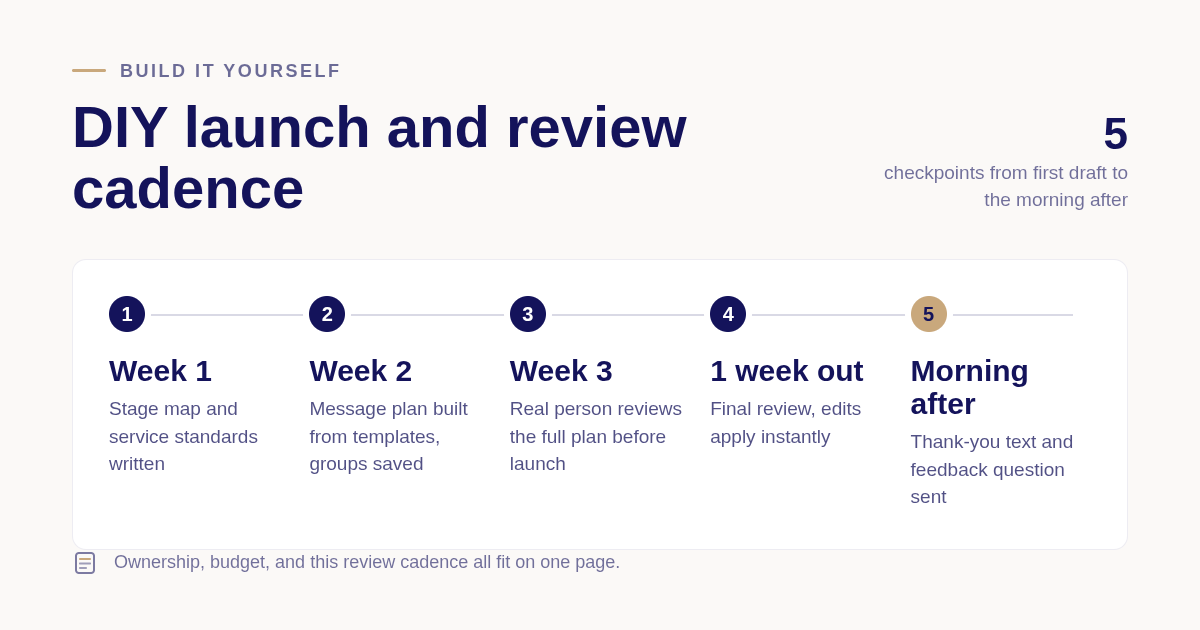
Section five is cadence. Review the plan at four weeks out, one week out, the night before, and the week after. For a destination wedding, our stress-free destination wedding guest coordination plan lays out the exact message timeline you can paste into section three.
How much does it cost and how long does a DIY guest experience program take to launch?
A DIY program costs the price of your communication channel plus your time. With a group text and a spreadsheet, the cash cost is zero and the time cost is every message sent by hand at the right hour. With Dearest Guest, every guest is included at the same $3.
Week one is the stage map and standards. Week two is the message plan, which is faster than it sounds because you start from templates and add unlimited custom messages for free. Week three is the review, where a real person on our team checks your whole plan before anything sends.
After that, your edits apply instantly, protected by automatic safety checks. The venue does not change the price. Jamaica, Tuscany, or Mexico, a guest with a number from the US, Canada, Europe, or beyond is the same $3, and we confirm delivery for your guests' countries with you before launch.
For the full breakdown of what is included, see the wedding invitation text pricing page. The honest limit: Dearest Guest covers the communication layer only. Staff greetings, room comfort, and in-person service recovery still depend on the people you name in section four of your template.
How did we put this guide together?
We compared the hospitality frameworks that appear in the top-ranking guides for this search, including the 10/5/3 rule, the 5 C's, and the five-stage journey, against the published scope of enterprise guest experience tools and the message plans from weddings Dearest Guest has run across sixteen destinations in nine countries.
How do you get started with Dearest Guest?
Start by adding your guest list, choosing the moments you want covered, and letting our team review the plan before the first text sends. Most couples finish the guest list in under five minutes, and every message is personalized to each guest. You stay present; your guests stay informed.
See exactly how wedding guest texting works, then build your program with us.
What do people also ask?
What is the 10/5/3 rule in hospitality?
The 10/5/3 rule is a greeting standard: at ten feet, make eye contact and smile; at five feet, offer a spoken greeting; at three feet, engage with a question or offer to help. It gives staff, hosts, or a wedding party a physical cue so no guest walks past unacknowledged.
What are the 5 C's of hospitality?
The 5 C's are care, comfort, communication, consistency, and convenience. Lists vary by source, but these five cover what guests notice most. Use them as a checklist against each stage of the guest journey, confirming every C is present before you finalize the program.
What are the five stages of guest experience?
The five stages are pre-arrival, arrival, the stay, departure, and post-stay. Every guest passes through all five. A guest experience program writes down what the guest needs to know, what they should feel, and what could go wrong at each stage, then assigns one message and one owner to each.
What are the three elements of guest experience?
Hospitality trainers usually describe three elements: the physical environment, the people delivering service, and the communication surrounding the stay. The first two depend on budget and staff. The third is the one a couple, planner, or small venue can build well without an enterprise tool, using personalized texts timed to each stage.
How much does it cost to build a guest experience program yourself with Dearest Guest?
Every guest is included at the same $3 whether their number is from the US, Canada, Europe, or beyond, and the venue does not change the price. Unlimited custom messages are free to add. Staff training and physical comforts are separate costs you set yourself.