

Why Dearestguest and Booking.com Do Different Jobs for Your Wedding Guests
Dearestguest texts every wedding guest by name for $3 each; Booking.com reserves hotel rooms. Learn why destination couples pair the two and which handles what.

Searching for Dearestguest vs Booking.com usually means you are planning a wedding or hosting travelers and want to know which tool does what, and the short answer is that they do completely different jobs. Dearest Guest is a wedding guest texting service, $3 per guest with unlimited messages, that tells every guest where to be and when. Booking.com is an online travel agency for reserving hotel rooms. Dearest Guest is not a booking site, and Booking.com does not message your guests, so most destination couples end up using both.
Key takeaways
- Different categories: Dearest Guest sends personalized wedding texts to each guest by name, at $3 per guest with unlimited messages; it does not reserve rooms or flights.
- Booking.com is an OTA: it is owned by Booking Holdings, free for travelers, and paid by properties through a commission on completed stays.
- Verified reviews only: Booking.com scores come from guests who completed a stay booked on the platform, rated 1 to 10 across categories like staff, cleanliness, and location.
- Proven abroad: Dearest Guest has coordinated guests across sixteen destinations in nine countries, and a real person reviews every message plan before launch.
- Ownership check: Hotels.com belongs to Expedia Group, not Booking.com. KAYAK, Priceline, and Agoda are Booking Holdings brands.

Is Dearest Guest a booking site or an alternative to Booking.com?
Dearest Guest is not a booking site and not an alternative to Booking.com. It is a wedding guest texting service that sends each guest personalized messages about travel, shuttles, the ceremony, and thank-yous. Booking.com reserves hotel rooms and rentals. The two never overlap: one gets guests a bed, the other gets them to the right place on time.
The confusion is understandable. Both names contain the word guest, both touch travel, and the search results for this query mix a review-mechanics article, a how-it-works snippet, and a generic list of hotel sites. None of them says plainly that these are two product categories.
Here is the practical picture. Your cousin books her Tulum hotel on Booking.com. A week before she flies, she gets a text from us with her shuttle pickup time matched to her flight. Booking.com got her the room; we got her to the welcome dinner.
Everything we send arrives as a plain text with nothing to download, no app, and no login. If you want to see each step of the setup, the walkthrough of how wedding guest texting works shows the full flow from spreadsheet to send.
What does Dearest Guest actually do, in three steps?
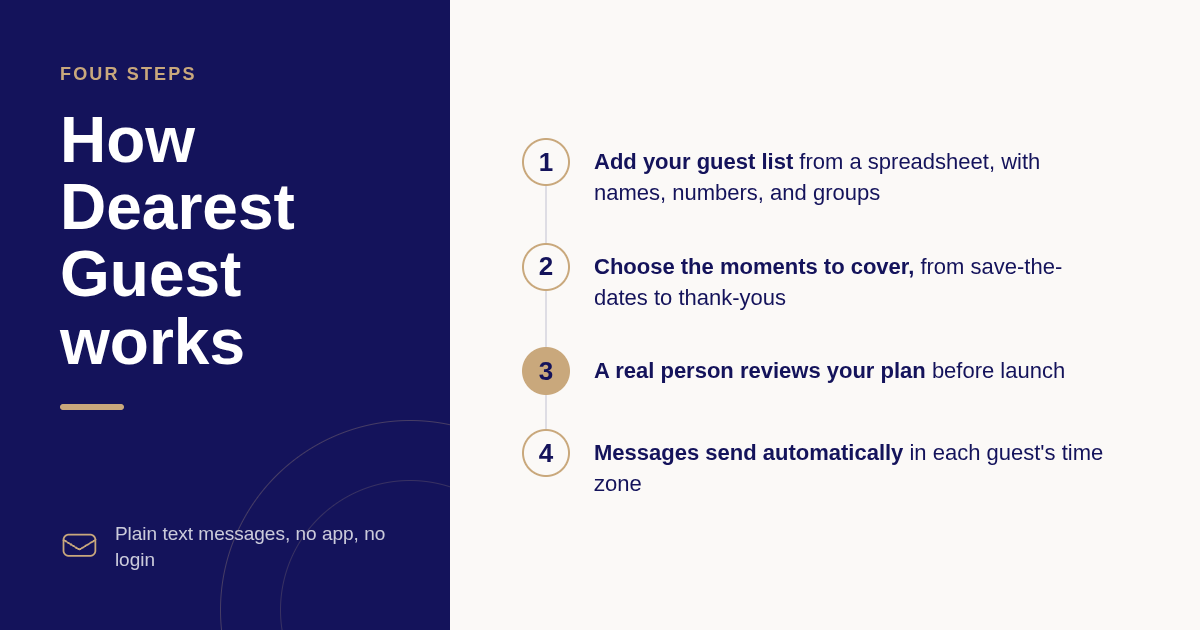
Dearest Guest works in three steps. First, you add your guest list from a spreadsheet or by hand, with names, numbers, and groups. Second, you choose the moments to cover, from save-the-dates to thank-yous, using templates or your own words. Third, we send each message automatically at the right time in every guest's time zone.
Step one takes most couples under five minutes. You can tag groups as you go, such as the early arrivals, the girls, or the family flying in together. Each group gets its own messages, prescheduled to go out with each guest's own name, never one blast to everyone.
Step two covers the moments you pick: save-the-dates, RSVP reminders, travel and flight info, hotel and room block deadlines, welcome notes on arrival, ceremony timing, day-of reminders, shuttle details, and thank-you notes. Custom messages are unlimited and free, and you preview exactly what each guest will see.
Step three is where care shows. A real person reviews your whole plan before launch. After that your edits apply instantly, protected by automatic safety checks, and every send is tracked. Replies collect quietly in your dashboard, so you read them when you like instead of fielding texts at the rehearsal dinner.
For a sense of scale, one Tulum wedding we ran had 60 guests flying in from across the country. Each received shuttle details specific to their flight, plus the full itinerary covering the welcome dinner, catamaran day, ceremony, and after party. You can read the actual messages on our page of real wedding guest texting examples.
How does Booking.com work for travelers and properties?
Booking.com is an online travel agency, or OTA. Travelers search hotels, apartments, and vacation rentals, compare prices and reviews, and reserve directly on the platform at no booking fee. Properties list their inventory, set rates and availability, and pay Booking.com a commission on completed stays. The platform handles distribution and reservations, not guest communication.
Booking.com is the largest brand of Booking Holdings, a publicly traded company whose annual report filed with the U.S. Securities and Exchange Commission also lists Priceline, Agoda, KAYAK, and OpenTable among its brands. The group operates as a marketplace: it does not own the hotels it lists.
For a wedding, this matters in one specific way. When guests book individually on Booking.com, you have no visibility into who reserved what, when they arrive, or whether they picked the right property. The hotel sees a reservation, not a wedding party.
That is why planners pair a room block or an OTA link with a separate communication plan. The booking channel fills beds. Something else has to tell 60 people which exit to walk out of at the airport.
Where do Booking.com's review scores come from?
Booking.com review scores come only from guests who completed a stay they reserved through the platform. After checkout, the guest is invited to rate the property from 1 to 10 across categories such as staff, cleanliness, comfort, facilities, location, and value for money, plus write comments. The overall score is an average of those verified reviews.
Because the invitation is tied to a completed reservation, Booking.com's system is a verified-stay model rather than an open review board. Reviewers can choose to post anonymously, and the property can respond publicly. The approach lines up with the direction regulators are pushing: the Federal Trade Commission's 2024 rule banning fake reviews targets reviews written by people who never had the experience.
Dearest Guest does not collect ratings or publish reviews. What we collect is replies: RSVPs, shuttle confirmations, dietary notes, and the occasional "we landed!" All of it lands in your dashboard, tied to the guest who sent it.
If you are specifically after guest photos, neither tool is a photo gallery. What we can do is text every guest the morning after with a link to your shared album, the way one couple in Riviera Maya did: a thank-you, a heart, and one line asking guests to add their photos.
Which one should a wedding couple or venue use?
Use Booking.com, or a hotel room block, when guests need to reserve somewhere to sleep. Use Dearest Guest when guests need to know flight details, shuttle pickups, the welcome dinner time, and where to park. A destination couple typically needs both.
Here is the side-by-side view the current search results are missing.
| Feature | Dearest Guest | Booking.com |
|---|---|---|
| Purpose | Personalized wedding guest texts | Reserving hotels and rentals |
| Primary users | Couples, planners, venues hosting weddings | Travelers and property owners |
| Who pays | The couple or host | The property, by commission |
| Pricing model | $3 per guest, unlimited messages | Free to travelers; commission on completed stays |
| Guest communication | Core product, by name, in each time zone | Reservation confirmations only |
| Reviews and feedback | Guest replies collected in your dashboard | Verified 1 to 10 reviews after checkout |
| Photo capture | Texts a link to your shared album | None |
| App required | No, plain text only | Website or Booking.com app |
| Data ownership | Your guest list and replies stay with you | Reservation data held by the platform |
A simple decision rule: if the question starts with "where do I sleep," that is Booking.com or your room block. If the question starts with "where do I go" or "what time," that is Dearest Guest.
Destination weddings make the split obvious. Marry in Jamaica, Tuscany, or Mexico and the venue does not change your price with us, and we confirm delivery for your guests' countries before anything sends. Our destination wedding messaging page shows the full sequence from the first hello to the morning-after note.
Which five tools cover booking, briefing, and arriving on time for wedding guests?
The five tools that cover the full guest journey are Dearest Guest for personalized texts, Booking.com for reserving rooms, Zola for a website and registry, Joy for a schedule app, and TextMyGuests for do-it-yourself bulk SMS. Each does one job well; none does all five, so rank them by the job you need done most.
Dearest Guest is best when every guest needs their own text at the right moment. Every guest is included at the same $3 whether their number is from the US, Canada, Europe, or beyond, messages are unlimited, and a real person reviews your plan before launch. The honest limit: we do not book rooms or flights, so you still need a room block or an OTA link for lodging.
Booking.com is best when guests need to reserve a room in a place where you cannot negotiate a block. It is free for travelers and shows verified 1 to 10 reviews from completed stays. The limit: you get no visibility into who booked, and the platform sends nothing about your wedding. Group blocks are arranged with the hotel directly, not through Booking.com.
Zola is best when you want a wedding website, registry, and RSVP form in one free account. Zola publishes free wedding websites on its site. The limit: updates depend on guests opening the website or an email, so time-sensitive changes can sit unread. Confirm current messaging features on zola.com.
Joy is best when you want a guest-facing app with the schedule, travel info, and photo sharing in one place. Joy offers its website and app free. The limit: the full experience asks guests to download the app or log in, and a share of every guest list never will.
TextMyGuests is best for do-it-yourself bulk SMS when you are comfortable writing, scheduling, and checking everything yourself. It is a self-serve tool sold by plan; confirm current pricing on its website. The limit: it is a broadcast tool, so personalization and quality control are on you, and nobody reviews the plan before it sends.
| Option | Best for | Pricing or format | Standout limit |
|---|---|---|---|
| Dearest Guest | Every guest texted by name at the right moment | $3 per guest, unlimited messages | Does not reserve rooms or flights |
| Booking.com | Reserving rooms where no block exists | Free to travelers, commission paid by property | No wedding messaging or guest visibility |
| Zola | Website, registry, and RSVP in one | Free wedding website | Guests must visit the site or open email |
| Joy | Guest app with schedule and photos | Free website and app | Guests must download or log in |
| TextMyGuests | DIY bulk SMS | Self-serve plans, confirm on site | Broadcast tool, no human review |
Can a venue or small hotel use Dearest Guest alongside Booking.com?
Yes. A venue or small hotel keeps Booking.com as its acquisition channel and uses Dearest Guest for the wedding weekends it hosts. Booking.com fills rooms; Dearest Guest texts each wedding guest the shuttle time, welcome reception, and run-of-show. The property can expect fewer front-desk questions, and the couple stays present instead of answering their phone.
The pairing works because the two tools hand off cleanly. Booking.com, or the hotel's own block, handles the reservation and the payment. Our hotel and accommodation messages then send room block deadlines, booking cutoffs, and check-in details before each cutoff, so the rooms a property set aside actually get taken.
On arrival day the handoff shows. One Riviera Maya wedding we ran texted every guest that airport transfers to and from the resort were included in their package, then followed with pickups matched to the flights on file. Those texts went out as plain messages with a reply-to-opt-out line, nothing for guests to download.
City weddings get the same treatment. A Philadelphia couple with a cathedral ceremony and a reception across town had us send parking lots for both venues and hotel shuttle times at 3:15 PM and 3:45 PM. Their words: not a single "where do I park?" text on the wedding day.
If you are mapping the travel sequence yourself, our guide to texting flight and hotel info to wedding guests lays out when each message should go and what it should say.
Who actually pays for Dearest Guest, and who pays Booking.com?
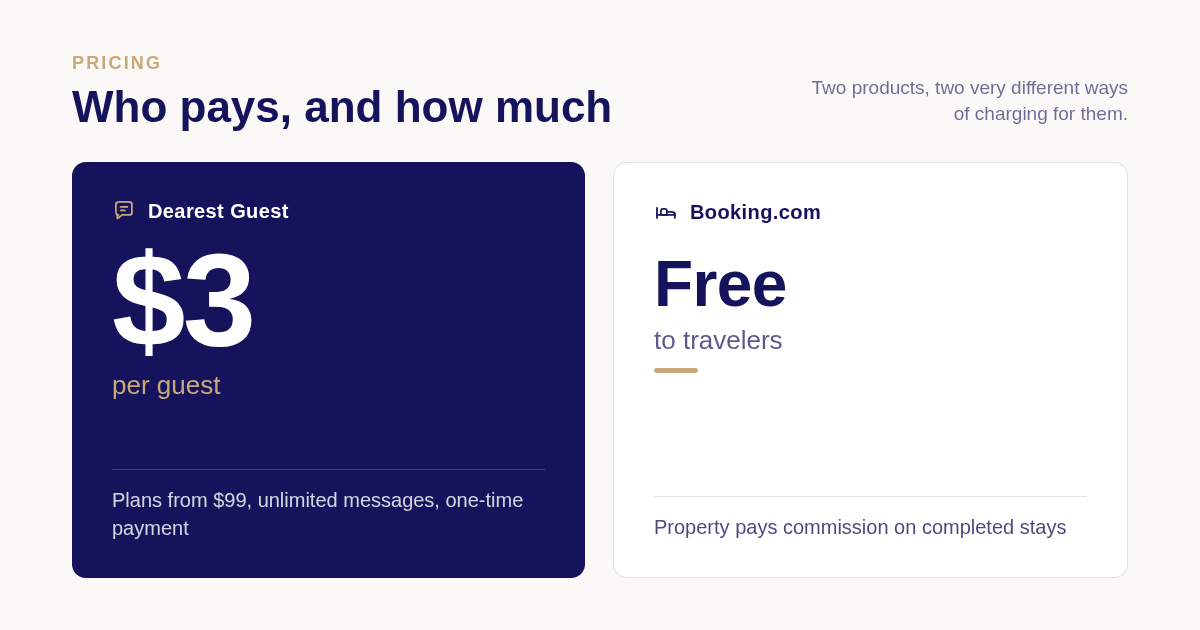
Dearest Guest is paid by the couple or host: every guest is included at the same $3 whether their number is from the US, Canada, Europe, or beyond, and custom messages are unlimited and free. Booking.com is free for the traveler; the property pays a commission on each completed reservation.
Our model is deliberately flat. There is no surcharge for international numbers, the venue country does not change the price, and custom messages are free. The full breakdown is on our wedding text pricing page.
Booking.com's model is the inverse: the guest sees no fee, and the economics sit with the property. Commission rates vary by country and property type, and Booking.com publishes the details for partners on its partner hub rather than on the public site. If you run a venue, confirm your rate there.
For a couple, the practical cost question is simple. You pay $3 for each guest you want kept informed. Your guests pay for their own rooms, wherever they book them.
Who are Booking.com's main competitors, and is Hotels.com the same company?
Booking.com's main competitors are Expedia Group brands (Expedia, Hotels.com, Vrbo), Airbnb, Trip.com Group, and metasearch sites like Google Hotels and Trivago. Hotels.com is not a Booking.com company; it belongs to Expedia Group. KAYAK, Priceline, and Agoda are sister brands under Booking Holdings, so they share an owner but run as separate sites.
The ownership map matters when guests ask you which site to trust. A hotel listed on Booking.com, Priceline, and Agoda is drawing from the same corporate family, while Hotels.com and Expedia draw from a different one. Prices can still differ between sister sites because each runs its own promotions.
On trustworthiness, the safest approach is to book directly with the hotel when a room block exists, and otherwise use a major OTA with verified reviews and clear cancellation terms. Booking.com's scale is significant enough that the European Commission designated it a gatekeeper under the Digital Markets Act in 2024, which brings specific obligations around how it treats partner hotels.
None of this changes the core point for a wedding. Whichever site your guests reserve on, they still need someone to tell them the welcome dinner starts at 6:00 PM on the rooftop.
What sources did this comparison draw on?
We compared published pricing pages, product and help pages, and the stated scope of each tool: what it does, who pays, whether guests need an app, and how feedback is collected. For Dearest Guest we used our own pricing and the real messages from weddings we ran.
What is the first step to texting your guests with Dearest Guest?
Getting started takes three steps: add your guest list from a spreadsheet, pick the moments you want covered, and let us schedule every message in each guest's time zone. A real person reviews the plan before anything sends. Most couples finish setup in under five minutes, and guests receive plain texts with nothing to download.
If your guests are booking rooms on Booking.com, a hotel block, or anywhere else, we are the layer that tells them what happens next. See how Dearest Guest works and start your guest list.
What do people also ask?
Are Booking.com and Hotels.com the same company?
No. Booking.com is owned by Booking Holdings, while Hotels.com belongs to Expedia Group, a separate publicly traded company that also owns Expedia and Vrbo. They compete directly and run different review and loyalty systems.
Who are Booking.com's main competitors?
Booking.com's main competitors are Expedia Group (Expedia, Hotels.com, Vrbo), Airbnb, Trip.com Group, and metasearch sites such as Google Hotels and Trivago. Its sister brands Priceline, Agoda, and KAYAK share the same parent, so they are not competitors in the ownership sense.
What is the most trustworthy hotel booking site?
For a wedding, the most reliable option is booking directly with the hotel holding your room block. Otherwise, use a major OTA with verified post-stay reviews and clear cancellation terms, such as Booking.com or Expedia, and compare the same room on both before reserving.
Are KAYAK and Booking.com the same?
They share an owner but are different products. KAYAK is a metasearch engine that compares prices across sites, while Booking.com is an online travel agency where you complete the reservation. Both belong to Booking Holdings.
Is Dearest Guest an alternative to Booking.com?
No. Dearest Guest is a wedding guest texting service, $3 per guest with unlimited messages, that sends each guest personalized texts about travel, shuttles, timing, and thank-yous. It does not reserve rooms. Use Booking.com or a room block for lodging and Dearest Guest to keep guests informed.