

Best Hospitality Software for Small Businesses
Best hospitality software for small businesses, ranked by job: Dearest Guest texts every guest by name for a one-time fee from $99. See the full comparison.

The best hospitality software for small businesses depends on the job you need done. For guest communication around a wedding weekend or hosted event, we rank Dearest Guest first: every guest gets their own text by name, plans start at $99 as a one-time payment with unlimited messages, and every guest is included at the same $3 whether their number is from the US, Canada, Europe, or beyond. Dearest Guest is not a property management system. It does not manage rooms, rates, or OTA channels, so for a hotel or B&B front desk the strongest small-property picks are Cloudbeds, Little Hotelier, Mews, and RoomRaccoon.
Key takeaways
- Five categories, one starting point: hospitality software splits into PMS, booking engine with channel manager, POS, accounting, and guest communication. Lodging businesses buy the PMS first.
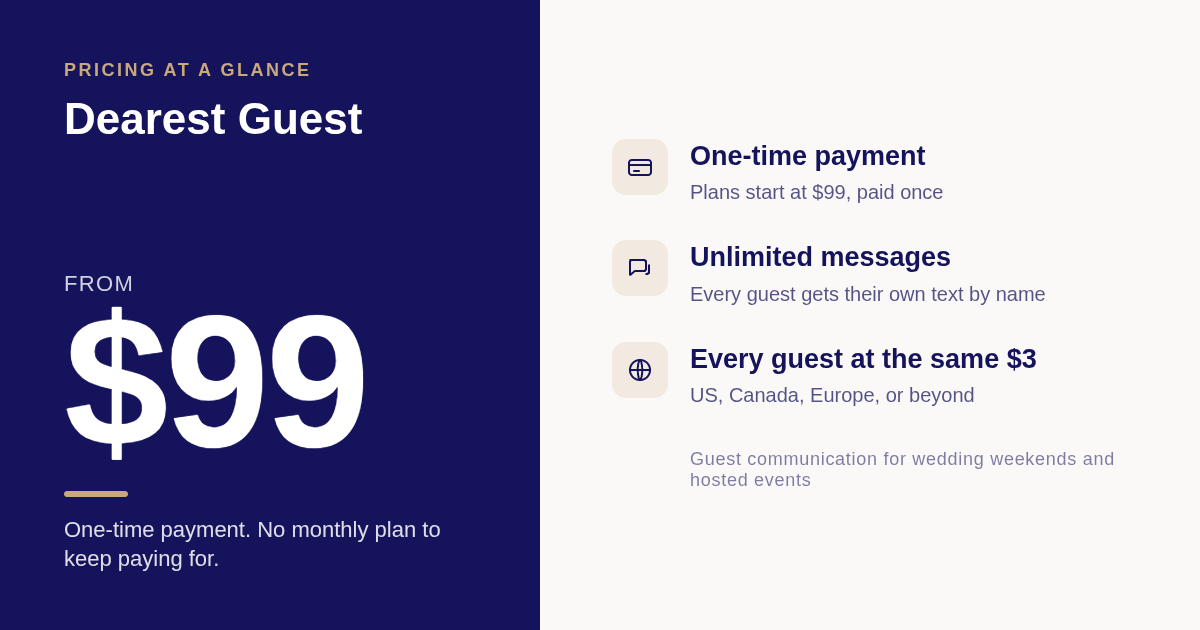
- Dearest Guest pricing is flat: plans from $99, one-time payment, unlimited messages, and every guest included at the same $3 regardless of country or venue.
- Most small-hotel PMS vendors price per property or per room per month, and Cloudbeds does not publish a price list, so a real budget only exists after a quote.
- Free booking tools earn somewhere: booking commissions, payment processing margins, room caps, or a paid channel manager add-on.
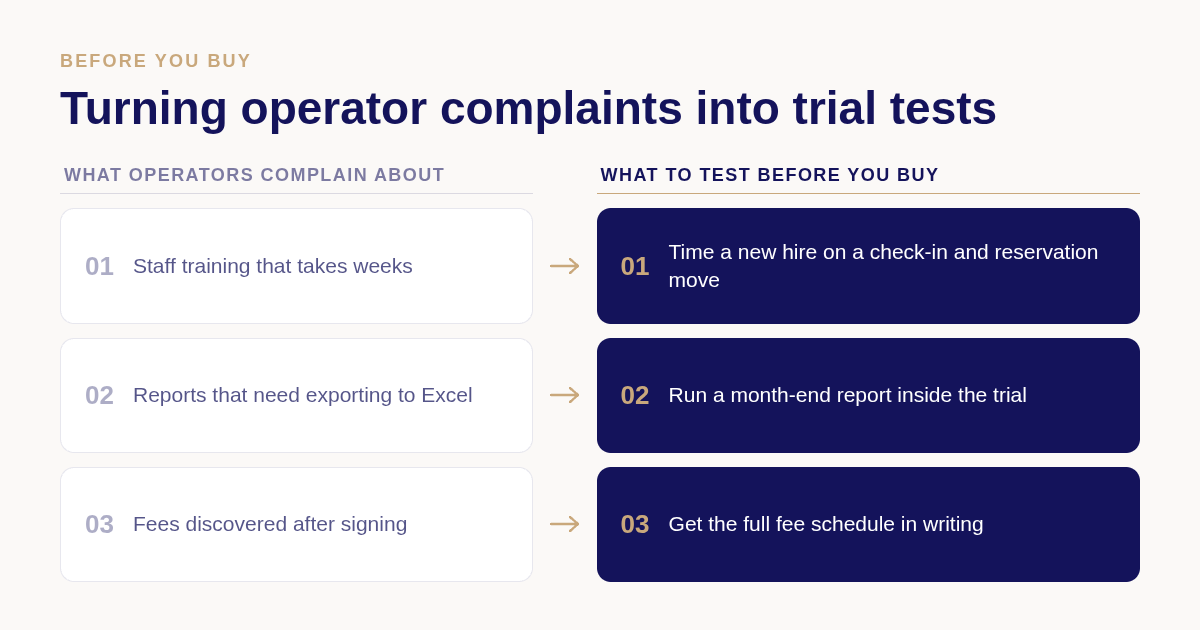
- Operators complain about three things: training time, reporting that needs Excel, and fees found after signing. Test all three in a trial before you commit.

What does hospitality software include for a small business, and what should you buy first?
Hospitality software for a small business splits into five categories: a property management system for rooms and rates, a booking engine with channel manager for direct and OTA reservations, point of sale for food and drink, accounting, and guest communication. Lodging businesses should buy the PMS first; restaurants start with POS; event hosts start with communication.
Most ranking pages for this search are hotel-only. That hides the fact that 'hospitality' covers cafes, bars, hostels, vacation rentals, event venues, and the couples and planners running a three-day wedding weekend. Each of those businesses has a different first purchase.
A hotel or B&B needs a property management system because it holds the room inventory everything else depends on. The booking engine and channel manager sit on top of it, pushing availability to Booking.com, Expedia, and your own website so two guests never get the same room.
A restaurant or cafe starts with point of sale, where tools like Toast and Square handle orders, tips, and tables. A vacation rental host with listings on Airbnb and Vrbo needs multi-listing sync from a tool like Lodgify or Hostaway. Accounting products such as M3 and Inn-Flow come later, once the operation is large enough to need departmental reporting.
Guest communication is the category most lists skip entirely. For a hosted weekend, it is the whole job: travel notes, shuttle pickups, the day-of timeline, and a thank-you the morning after. That is where we sit, and why we rank ourselves first for that job only.
Which are the top 5 best hospitality software options for small businesses?
Ranked by the job each does best: Dearest Guest for guest communication at weddings and hosted weekends, Cloudbeds for an all-in-one PMS with the deepest channel connections, Little Hotelier for the simplest small-property front desk, Mews for integration-heavy boutique hotels, and RoomRaccoon for independents wanting built-in revenue tools. Every option below lists one checkable fact and one honest limit.
Dearest Guest: best when the job is getting every guest to the right place at the right time. We send automated, personalized text messages to wedding guests, from the save-the-date to the morning-after thank-you. You drop in a spreadsheet, group guests (the early arrivals, the family flying in together), choose or write messages, and everything prescheduled sends automatically in each guest's time zone. A real person reviews the whole message plan before launch, every send is tracked, and replies collect in your dashboard. Pricing is a one-time payment with plans from $99, unlimited messages, and every guest included at the same $3. The honest limit: we are not a PMS. There is no room inventory, OTA sync, or POS, and we are built for weddings and hosted weekends rather than daily hotel operations. See exactly how the three-step setup works before deciding.
Cloudbeds: best when you need PMS, booking engine, and channel manager in one platform. Cloudbeds bundles front desk, direct booking, channel management, and payments for independent hotels, hostels, and vacation rentals, with a broad marketplace of third-party connections. The checkable fact is its pricing model: Cloudbeds does not publish a public price list and quotes per property, so confirm current terms on cloudbeds.com. The limit is that quote-only pricing slows budgeting, and operators commonly report a longer setup than simpler tools.
Little Hotelier: best for B&Bs and small properties that want the simplest front desk. Built by SiteMinder specifically for small accommodation businesses, Little Hotelier packages a front desk, booking engine, and channel manager into a per-property subscription with published plan tiers (verify the current figures on littlehotelier.com). It is widely described as quick to learn. The limit is depth: reporting and integrations are lighter than Cloudbeds or Mews, and properties that grow past a small inventory often outgrow it.
Mews: best for boutique hotels that want a large integration marketplace. Mews is a cloud PMS with a marketplace of hundreds of connected apps covering revenue management, housekeeping, and guest messaging, and it is especially strong in Europe. Its pricing combines a subscription with payment processing through Mews Payments, so your real cost depends on card volume; check mews.com for current terms. The limit is that Mews brings more configuration than a ten-room inn needs, and the payment-processing component is hard to avoid.
RoomRaccoon: best for independents that want upsell and revenue tools built in. RoomRaccoon is an all-in-one PMS, channel manager, booking engine, and payments platform aimed at independent hotels and B&Bs, with tiered plans priced by room count (confirm on roomraccoon.com). It includes automated upsells and yield features that usually cost extra elsewhere. The limit is a smaller integration ecosystem than Mews or Cloudbeds, and its footprint is strongest in Europe and South Africa, so North American support hours deserve a check.
| Option | Best for | Pricing or format | Standout limit |
|---|---|---|---|
| Dearest Guest | Guest texting for wedding weekends and hosted events | One-time payment, plans from $99, $3 per guest, unlimited messages | Not a PMS: no rooms, OTA sync, or POS |
| Cloudbeds | All-in-one PMS with deep channel connections | Quote-based per property, no public price list | Longer setup, budgeting waits on a quote |
| Little Hotelier | B&Bs and small inns wanting simplicity | Per-property subscription, published tiers | Lighter reporting and integrations |
| Mews | Integration-heavy boutique hotels | Subscription plus payment processing | More configuration than tiny properties need |
| RoomRaccoon | Independents wanting built-in upsells | Tiered plans priced by room count | Smaller integration ecosystem |
How much does small hotel management software cost per month?
Small hotel PMS pricing follows three models: a flat monthly fee per property, a per-room monthly rate that scales with inventory, or a subscription plus payment and booking fees. A sub-$800 monthly budget typically covers an all-in-one plan for a 10 to 50 room property, but add-ons for channel managers, booking engines, and onboarding often sit outside the headline price.
The headline subscription is rarely the whole bill. Watch for four line items that appear after the demo: a one-time onboarding or setup fee, a per-booking commission on direct reservations, a payment processing margin on top of card fees, and per-channel pricing when you connect more than a few OTAs.
A useful discipline is to ask every vendor for a twelve-month total cost at your current room count and booking volume, with every add-on itemized. Then divide by twelve. That number, not the starting price on the pricing page, is what you compare across Cloudbeds, Little Hotelier, Mews, and RoomRaccoon.
Our model is deliberately different because the job is different. There is no monthly subscription and no per-message fee. You pay once, choose a plan starting at $99, add unlimited messages, and every guest costs the same $3 whether they are in Toronto, Tuscany, or Tulum. The full breakdown is on our wedding texting pricing page, and the venue does not change the price.
Is there genuinely free hotel booking software, and what is the catch?
Yes, free hotel booking and management tools exist, but the catch is how they earn. Most charge a commission on each booking, keep a margin on payment processing, cap rooms or users, or sell the channel manager as a paid add-on. Free works for a handful of rooms; past that, a transparent flat plan usually costs less per year.
The free tier makes sense if you have two or three rooms and take most bookings by phone. It stops making sense the month your OTA bookings grow, because commission-based models scale their fee with your success while a flat subscription does not.
Before accepting a free plan, read the fee schedule for three things: the percentage taken on each booking, the room or user cap, and whether the channel manager is included or sold separately. The U.S. Small Business Administration publishes free guidance on managing costs and contracts for small operators at sba.gov, which is worth a read before signing any software agreement.
One more catch rarely mentioned: free tools often lock export. If you cannot download your guest and reservation history in a standard format, the eventual migration to a paid PMS will cost more than the subscription you saved.
Why does cloud-based software win for small operators?
Cloud hospitality software wins for small operators because it removes the server, the IT contract, and the manual update cycle. Staff log in from any device, OTA availability syncs in real time to prevent double bookings, and the vendor handles backups and security patches. On-premise systems only make sense when internet is unreliable at the property.
The practical test is simple: can the owner check tonight's arrivals from a phone at dinner? With cloud PMS tools like Cloudbeds, Mews, and RoomRaccoon, yes. Long-standing on-premise names such as roommaster have added cloud editions for the same reason, and most new buyers should default to the cloud option.
The same logic applies to how you reach guests. About nine in ten American adults now own a smartphone, according to the Pew Research Center's mobile fact sheet, yet very few will download a one-off app for a single stay or a single wedding.
That is why every Dearest Guest message arrives as a plain text with nothing to download. A save-the-date, a shuttle time, or a welcome note the moment a guest lands all appear in the same thread they already read, under a saved contact name like 'A & J Wedding'.
Which PMS is easiest for staff to learn, and what do real operators complain about?
Little Hotelier and RoomRaccoon are the tools operators most often describe as easy for front-desk staff to learn, while Cloudbeds and Mews reward a longer setup with deeper features. Operator threads on Reddit and hotel forums repeat the same three complaints: training that takes weeks, reports that need exporting to Excel, and fees discovered after signing.
Turn those complaints into trial tasks. Time how long a new hire needs to check in a walk-in, move a reservation, and post a charge without help; under an hour is a good sign. Run a month-end occupancy and revenue report inside the trial and see whether it answers your question or just produces a CSV.
Then ask the vendor for the complete fee schedule in writing, including processing margins, channel fees, and support tiers. Operators who later describe a tool as 'expensive' on Reddit are usually describing a fee they did not see at the demo, not the subscription itself.
We apply the same test to ourselves. Most couples finish adding their guest list in under five minutes, and a real person reviews the whole plan before launch, so the learning curve is close to zero. You can read the actual messages guests received at a 60-person Tulum beach wedding and a Philadelphia cathedral ceremony in our real wedding guest texting examples.
Should a 10 to 50 room boutique property choose differently than a restaurant, vacation rental, or event host?
Yes. A 10 to 50 room boutique property needs a PMS with a built-in channel manager and booking engine, and should shortlist Cloudbeds, Mews, or RoomRaccoon. A restaurant or cafe starts with POS. A vacation rental host needs multi-listing sync. A venue or couple hosting a wedding weekend needs guest communication, not inventory software.
Here is a decision rule by size. Under ten rooms, prioritize ease of use and a low flat fee, which points to Little Hotelier. Between ten and fifty rooms, prioritize a native channel manager, a booking engine with no per-booking commission, and reporting you can read without exporting, which points to Cloudbeds, Mews, or RoomRaccoon depending on which integrations you need.
Integration needs decide the tie. If you run a restaurant inside the hotel, check that the PMS posts POS charges to the folio. If an accountant will use M3 or Inn-Flow, confirm a supported export. If you plan dynamic pricing, see whether revenue management is native or a marketplace add-on.
Event hosts have a different checklist entirely. A couple bringing 60 guests to a beach resort needs each guest's shuttle details matched to their own flight, a full itinerary from welcome dinner to after party, and reminders timed to each time zone. That is the work our destination wedding messaging handles, across sixteen destinations and nine countries so far.
How hard is it to migrate from a legacy PMS, and what should you check first?
Migrating from a legacy PMS usually takes weeks rather than days, with most of the effort spent cleaning guest and reservation data before export. Check four things first: whether the new vendor imports future reservations, how OTA connections are re-mapped, what historical reporting survives, and whether onboarding is included or billed separately.
Schedule the switch for your lowest-occupancy month and run both systems in parallel for at least the first week of arrivals. Export everything from the old system before cancelling, including guest profiles, rate plans, and any future reservations, and keep a read-only copy for tax and audit purposes.
Guest data also carries consent obligations. If you intend to text guests from the new platform, confirm you have permission and that every message offers a way to opt out. The Federal Communications Commission enforces the rules on automated texts in the United States, and the penalties apply to small businesses too.
This is why our first message to every guest ends with 'Reply STOP to opt out', why we confirm delivery for your guests' countries with you before anything sends, and why your edits after launch are protected by automatic safety checks. Communication software should make compliance the default, not a setting to find.
How did we compare these options?
We compared each vendor's published pricing page and plan descriptions, the scope of what each product manages (rooms, channels, payments, or guest messaging), and the recurring operator complaints about training, reporting, and fees. Where a vendor publishes no price, we said so rather than estimating. Rankings reflect the job each tool does best, not one overall score.
How do you get started with Dearest Guest?
Getting started takes three steps: add your guest list from a spreadsheet or by hand, choose the moments you want covered from templates or your own words, and let every message send automatically at the right time in each guest's time zone. Our team reviews every message for quality before it goes out, so you stay present on the day.
If your hospitality software question is really a guest question (who needs to be where, and when), start your wedding guest texting plan with Dearest Guest and preview exactly what each guest will see before anything sends.
What do people also ask?
How much does small hotel management software cost per month?
Most small-hotel PMS vendors charge either a flat monthly fee per property or a per-room monthly rate, often plus payment processing, booking commissions, or setup fees. Cloudbeds quotes per property with no public price list, while Little Hotelier and RoomRaccoon publish tiers. Ask for a twelve-month itemized total before comparing. Dearest Guest, built for wedding guest texting rather than room management, is a one-time payment with plans from $99 and every guest included at $3.
Is there genuinely free hotel booking software, and what is the catch?
Free hotel booking tools exist, but they earn through booking commissions, payment processing margins, room or user caps, or a paid channel manager add-on. They suit two or three rooms with mostly phone bookings. Once OTA volume grows, a transparent flat subscription usually costs less per year, and paid tools are more likely to let you export your data when you move.
Which hotel PMS is easiest for staff to learn and has usable reporting?
Little Hotelier and RoomRaccoon are the options operators most often describe as quick for front-desk staff to learn. Cloudbeds and Mews offer deeper reporting and integrations but take longer to set up. Test both in a trial: time a new hire on a check-in and a reservation move, and run a month-end occupancy report to see whether it answers your question without an Excel export.
What is the best hospitality software for a 10 to 50 room boutique hotel?
For 10 to 50 rooms, choose a cloud PMS with a native channel manager and booking engine and no per-booking commission. Cloudbeds fits properties that want everything in one platform, Mews fits hotels that need a large integration marketplace, and RoomRaccoon fits independents that want upsells and yield tools built in. Confirm current pricing on each vendor's site, since fees vary by room count and payment volume.
Is Dearest Guest a hotel property management system?
No. Dearest Guest is a wedding guest communication service that sends automated, personalized text messages, from save-the-dates and RSVP reminders to shuttle times, day-of reminders, and thank-you notes. It does not manage rooms, rates, OTA channels, or point of sale. It is the right pick when the job is keeping every guest informed for a wedding weekend, and the wrong pick for running a hotel front desk.