

Best Guest Experience Software for Hotels
Best guest experience software for hotels, ranked by the job each does. Dearest Guest texts every wedding guest by name for $3 each. See the full comparison.

The best guest experience software for hotels depends on the job you need done. For hotels and resorts hosting a wedding or group weekend, we rank Dearest Guest first: every guest gets their own text by name, prescheduled in their own time zone, at $3 per guest, with nothing to download. Dearest Guest is not a property management system, a check-in kiosk, or a review tool. For those jobs, Canary Technologies, Duve, Revinate, and Mews are the strongest picks on this list.
Key takeaways
- Dearest Guest charges the same $3 per guest whether the guest's number is from the US, Canada, Europe, or beyond, and a real person reviews the whole message plan before anything sends.
- Guest experience software is not a PMS. It sits on top of OPERA, Mews, or Cloudbeds and handles guest-facing messaging, digital check-in, upsells, and feedback.
- Canary, Duve, and Revinate sell by quote, and Mews prices per property by subscription, so request a written proposal before you compare any of them on cost.
- Group weekends are the gap in stay-based hotel platforms: a reservation record does not know which guest lands at 11:44 AM or who rides the Friday shuttle.
- Every guest-facing text needs an opt-out, which is why the first Dearest Guest message ends with "Reply STOP to opt out."

What is guest experience software for hotels, and how is it different from a PMS?
Guest experience software is the guest-facing layer of a hotel's tech stack: messaging, digital check-in, mobile keys, upsells, surveys, and review management. A property management system (PMS) is the back office that holds reservations, rates, and housekeeping. Guest experience tools read from the PMS and talk to guests; the PMS rarely talks to guests at all.
Most pages ranking for this search blur the two. They list PMS vendors, channel managers, and booking engines under one heading, which makes shortlisting slow. This guide is scoped to tools a guest actually touches: the text, the check-in link, the upgrade offer, the survey.
The guest's phone is the channel for all of it. According to the Pew Research Center mobile fact sheet, 91% of US adults own a smartphone, which is why every tool below leans on SMS, WhatsApp, or a mobile web link rather than a printed welcome letter.
One more distinction matters for resorts. A wedding block of sixty rooms is a single group in the PMS, but it is sixty people with different flights, dinners, and shuttle times. That mismatch is where a dedicated group messaging layer earns its place, and it is why we rank one at the top.
Which are the top 5 best guest experience software options for hotels?
Ranked by the job each does best: Dearest Guest for wedding and group weekends arriving at a hotel, Canary Technologies for contactless check-in and upsells, Duve for WhatsApp-first guest communication, Revinate for guest data and marketing across a portfolio, and Mews when you want guest-facing tools built into a cloud PMS. Each has a clear limit, noted below.
Dearest Guest: best when a wedding or group weekend lands at your property. Every guest receives their own plain text, with their own name, never one blast to everyone. Guests are saved as groups in seconds (the early arrivals, the family flying in together), and each group gets its own prescheduled messages in each guest's time zone. The price is $3 per guest regardless of country, unlimited custom messages are free, a real person reviews the full plan before launch, and every send is tracked. We have run it across sixteen destinations in nine countries so far. Honest limit: it is not a hotel operations tool. There is no check-in, no mobile key, no upsell engine, and no PMS integration. Couples and planners typically run it, and a hotel's wedding team can recommend it or build the plan alongside the couple.
Canary Technologies: best for contactless check-in, digital authorizations, and upsells. Canary covers mobile check-in and checkout, digital registration cards, upsell offers, guest messaging, and digital tipping, and it lists integrations with Oracle OPERA and most major cloud PMSs. Pricing is by quote and is not published, so confirm current terms on canarytechnologies.com. Honest limit: everything is organized around the reservation lifecycle. A wedding party of sixty gets the same pre-arrival and in-stay messages as any other guest, not an itinerary tied to each person's flight.
Duve: best for WhatsApp-first communication and a branded guest web app. Duve combines pre-arrival check-in, a guest-facing web app for local recommendations and requests, upsells, and messaging across WhatsApp, SMS, and email. It lists connectors for Mews, Cloudbeds, and OPERA. Pricing is quote-based and scales with property size; request a proposal from duve.com. Honest limit: much of the content lives inside the guest web app, so guests have to open a link to see it, and messaging is still stay-centric rather than event-centric.
Revinate: best for guest data, email, and text marketing across a portfolio. Revinate's suite includes Revinate Marketing, Ivy for guest messaging, and Reservation Sales, all built on a central guest profile that can span several properties. Pricing is by annual contract and quote. Honest limit: it is designed for groups and management companies with a marketing team. A single independent hotel will find setup heavier than it needs, and the strongest features assume a large guest database.
Mews: best when you want guest-facing tools built into a cloud PMS. Mews is a PMS that bundles online check-in, kiosks, and payments, and its marketplace connects to guest experience partners including Duve and Canary. It prices per property on a subscription, with details on mews.com that vary by region and module. Honest limit: choosing Mews means a PMS migration, which is a months-long project. Native guest messaging is thinner than the dedicated tools above, so most Mews hotels still add a partner for communication.
| Option | Best for | Pricing or format | Standout limit |
|---|---|---|---|
| Dearest Guest | Wedding and group weekends arriving at a hotel or resort | $3 per guest, any country; unlimited custom messages free | No check-in, mobile key, upsells, or PMS integration |
| Canary Technologies | Contactless check-in, authorizations, upsells | Quote-based, not published | Messaging follows the reservation, not an event itinerary |
| Duve | WhatsApp-first communication and a guest web app | Quote-based, scales with property size | Guests must open a web app for most content |
| Revinate | Guest data and marketing across a portfolio | Annual contract by quote | Heavy for a single independent property |
| Mews | Guest tools inside a cloud PMS | Per-property subscription, varies by region | Requires a full PMS migration |
Two tools you will see on other lists deserve a mention. TrustYou focuses on surveys and review management rather than messaging, and Cloudbeds is a PMS with its own messaging add-on. Both fit the integration section below more than the ranked list.
How should you choose guest experience software for your hotel?
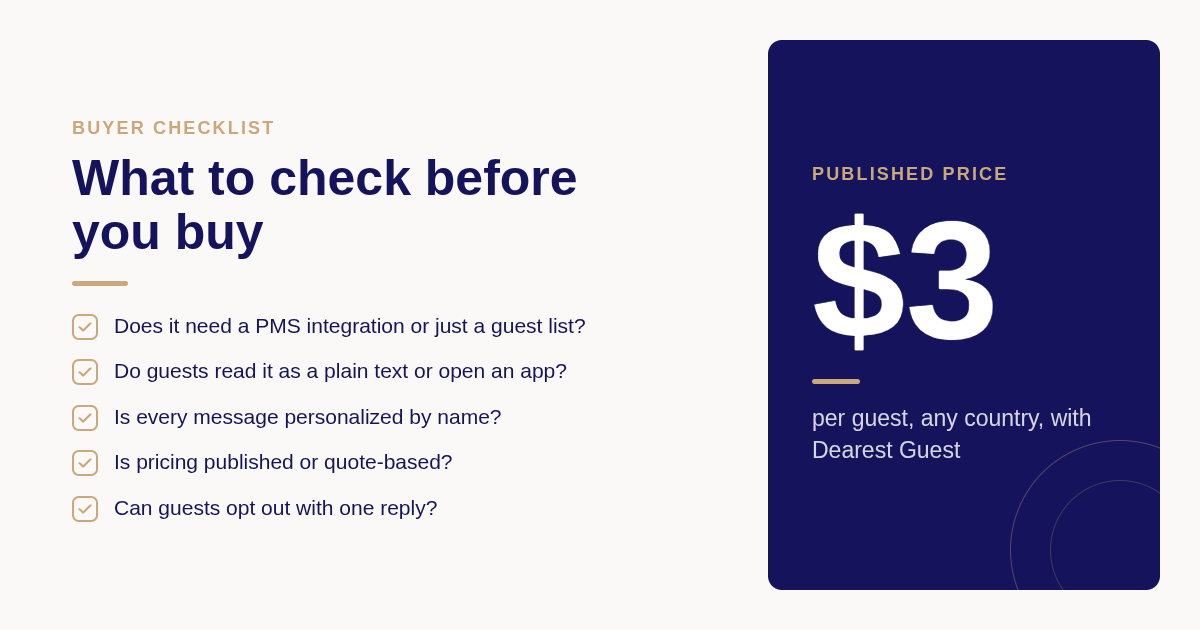
Choose by the job first, then by integration. If your pain is front-desk queues, start with contactless check-in. If it is unanswered guest questions, start with messaging. If it is a wedding block with sixty guests on different flights, choose a tool that sends each guest their own schedule. Only then compare PMS connectors, channels, support, and price.
We use five criteria, in this order. First, automation depth: does the tool send the right message at the right time without a staff member pressing a button? Second, integration: does it read reservation data from your PMS, and does it write back? Third, guest effort: does the guest need an app, an account, or a login?
Fourth, support: is a human reviewing your setup, or are you on your own with a help center? Fifth, pricing model: per room, per property, per guest, or per message. A tool that meters messages will quietly discourage the exact reminders guests value most.
A simple decision rule: if the guest has to download something to benefit, the feature will reach a fraction of your guests. Plain text, a web link, or a WhatsApp thread will reach nearly all of them.
Why does a wedding group at a hotel need its own messaging layer?
A hotel's guest platform knows a reservation: room, dates, rate. A wedding weekend is a different object: sixty people on different flights, a welcome dinner, shuttle windows, and one ceremony. Dearest Guest holds that schedule per guest, so the person landing at 11:44 AM gets their own pickup text while Friday arrivals get theirs the next day.
Here is what that looked like at a beachfront resort in Tulum. Sixty guests flew in from across the country for a multi-day celebration. Each one received shuttle details specific to their flight: arrival day, pickup time, and what to look for at the airport, plus a full itinerary covering the welcome dinner, catamaran day, ceremony, and after party.
One week out, a guest named Lauren got this: "Just 1 week until you land in Mexico! Your shuttle details: Landing at CUN at 11:44 AM. Your driver will be waiting outside the main exit, look for a sign saying Mia & Sam Wedding." The couple's verdict afterward: "Every guest knew exactly where to be and when, even the ones who'd never been to Mexico before."
The same structure works for a city hotel feeding a venue across town. For a Philadelphia wedding, guests staying at a hotel received shuttle departure times of 3:15 PM and 3:45 PM, return times, and parking lots at both the cathedral and the club. The couple reported "not a single 'where do I park?' text on the wedding day." You can read more real wedding guest texting examples by event type.
For resorts that host international groups, delivery across countries is the hard part. We confirm delivery for your guests' countries before anything sends, and the destination wedding messaging plan covers shuttle pickups, dinner plans, the day-of timeline, and a welcome note the moment guests land.
Which tools fit small independent hotels versus multi-property groups?
Small independent hotels get the most from Canary or Duve, both of which sell to single properties and connect to common cloud PMSs. Multi-property groups lean toward Revinate for shared guest data or Mews for a unified PMS. Any property that hosts weddings, regardless of size, can add Dearest Guest for the group itself without touching the hotel stack.
For an independent property under a hundred rooms, the limiting factor is usually staff time, not features. Pick one tool that automates the two or three messages you currently send by hand (pre-arrival, check-in link, departure survey) and ignore the rest of the module list until those run cleanly.
For a group of five or more properties, consistency wins. A shared guest profile, a shared message library, and a single reporting view matter more than any one property's favorite feature. That is Revinate's home turf, and it is where Mews makes sense if you are already planning to standardize your PMS.
Luxury and five-star properties often run two layers: a hotel platform for the stay, and a dedicated plan for each wedding or incentive group. If you host destination weddings, the stress-free destination wedding guest coordination plan shows the exact message timeline for a hundred traveling guests.
Does guest experience software integrate with OPERA, Mews, and Cloudbeds?
Canary, Duve, and Revinate all list integrations with Oracle OPERA, Mews, and Cloudbeds, though depth varies by connector, so ask for a two-way sync demo on your exact PMS version. Mews is itself a PMS. Dearest Guest does not integrate with any PMS; it takes a spreadsheet of names, numbers, and groups, which is the point for a wedding block.
Integration depth is where demos get vague. A "certified" connector might only pull arrivals once a night, or it might sync reservation changes in real time and write check-in status back. Ask the vendor to show a room move and a date change flowing through live, on your PMS, before signing.
If you run Cloudbeds, note that it sells its own messaging add-on, Whistle for Cloudbeds, which covers SMS and WhatsApp inside the PMS. Mews users typically add Duve or Canary through the Mews Marketplace. TrustYou connects to most PMSs for post-stay surveys and pushes review scores into its own dashboard.
For a wedding group, skipping integration is a feature, not a gap. The couple's guest list rarely matches the PMS room list one to one: some guests share rooms, some stay at a sister property, some drive in for one night. A spreadsheet with names, numbers, and groups is the cleaner source of truth, and most couples finish adding it in under five minutes.
How much does hotel guest experience software cost, and is there a free option?
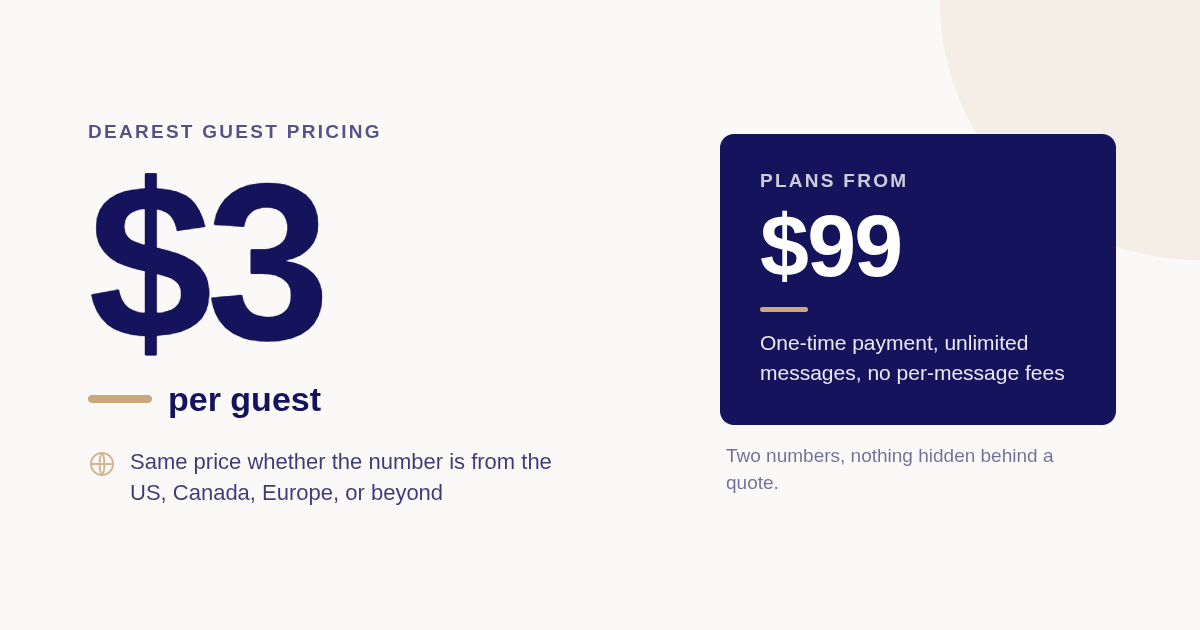
Most hotel guest experience platforms price by quote, usually scaled by room count and modules; the four hotel tools above either quote privately or publish starting points that change with region. Dearest Guest is the exception: every guest costs the same $3, whether their number is from the US, Canada, Europe, or beyond, and unlimited custom messages are included free.
Searches for a free option mostly turn up free trials and demos, not free tiers. None of Canary, Duve, Revinate, or Mews offers a permanently free plan for a working hotel. The genuinely free alternatives are group chats and mass-text apps, which cost nothing and deliver exactly that: no names, no scheduling, no review, and one reply-all thread for sixty people.
When you request quotes, ask three questions in writing. Is messaging metered per message or included? Does the per-room price change when you add a module? What does onboarding cost, and is it refundable if the integration fails? Threads on Reddit about hotel software are useful mainly as a source of those questions, not as ratings.
With Dearest Guest the venue does not change your price. A wedding in Jamaica, Tuscany, or Mexico costs the same per guest as one in Philadelphia. Full plan details are on the wedding guest texting pricing page, with everything included in a one-time plan rather than a monthly subscription.
What features matter most: messaging, check-in, upsells, surveys, or reputation?
Messaging matters most, because it is the feature guests actually experience; check-in, upsells, and surveys are all delivered through it. Rank features by the problem you measured last quarter: queue time points to check-in, low ancillary revenue points to upsells, review volume points to surveys. For event groups, per-guest scheduling outranks every other feature.
Inside messaging, three details separate good from adequate. Personalization by name and by guest-specific data, not a merge field that sometimes prints blank. Scheduling in the guest's time zone, so a 9 AM reminder is 9 AM where the guest is. And a human review step before launch, because a typo in a shuttle time reaches everyone at once.
Compliance is a feature too. Guest-facing texts need a clear opt-out and consent, and the FCC's guidance on unwanted texts explains why reply-STOP handling is expected on every automated thread. Dearest Guest's first message to each guest ends with "Reply STOP to opt out," and every send after that is tracked.
Upsells and mobile keys are valuable, but only where the hotel has the operations to fulfill them. An upgrade offer that the front desk cannot honor at arrival creates a complaint, not revenue. Buy the feature your team can deliver, not the one the demo highlighted.
How does guest experience software improve satisfaction and review scores?
Guest experience software improves satisfaction by removing the moments guests remember badly: a line at the desk, an unanswered question, a missed shuttle. Each tool attacks one of those. Personalization is the common thread; a message that uses a guest's name and their own details is read, while a blast to everyone is skimmed or ignored.
The expectation is now baseline. McKinsey's research on the value of getting personalization right found that 71% of consumers expect personalized interactions and 76% get frustrated when they do not get them. A pre-arrival text that knows the guest's name and arrival day is the cheapest form of personalization a hotel can offer.
The practical outcomes vendors advertise (faster check-in, fewer manual errors, higher survey scores, more upsell revenue) are real where the tool fits the job. Ask each vendor for a reference property of your size and segment rather than a portfolio-wide average.
For group weekends, the measurable outcome is simpler: how many guests arrived at the right place at the right time without calling the desk. A Riviera Maya arrival text in our files reads: "You made it! Check in, get settled, and meet us at 6:00 PM for passed apps and drinks in the garden. S'mores on the beach at 8." That is one fewer question at the front desk, sixty times over.
How did we compare these options?
We compared published pricing pages, feature and integration pages, and the scope each vendor claims for its own product, as of writing. We did not run a lab test or survey hoteliers. Dearest Guest facts come from our own product and pricing pages; competitor facts come from their public sites, so confirm current details before you sign.
Rankings are by the job each tool does best, not by an overall score, because a check-in platform and a group messaging service are not competing for the same budget line. Where a vendor does not publish a price, we say so rather than estimate one.
How do you get started with Dearest Guest?
Add your guest list from a spreadsheet, choose the messages you want covered, and we review and schedule every send. Most couples finish the list in under five minutes. If your hotel is hosting a wedding or group weekend, see how it works and start a plan with the couple today.
There are three steps. Drop in names, phone numbers, and groups. Pick the moments to cover, from save-the-dates and hotel booking deadlines to shuttle pickups and the morning-after thank-you, starting from our templates or writing your own. Then our team reviews each message, and everything sends automatically at the right time in each guest's time zone.
See exactly how Dearest Guest works and build the message plan for your next wedding weekend.
What do people also ask?
How do you enhance the guest experience in a hotel?
Remove the moments guests remember badly: desk queues, unanswered questions, and missed logistics. Use contactless check-in for arrivals, a messaging tool guests can reply to, and, for wedding or group weekends, per-guest texts that carry each person's own shuttle time and schedule. Personalize by name and send in the guest's time zone.
What is the best online booking software for hotels?
Booking engines are a different category from guest experience software. Mews and Cloudbeds both bundle a booking engine with their PMS, and most independent hotels choose one of those or a standalone engine that connects to their PMS. Guest experience tools like Canary, Duve, and Dearest Guest start working after the booking exists.
Which PMS software is best for a small hotel?
Mews and Cloudbeds are the most common cloud PMS choices for small and independent hotels, and both have marketplaces that connect to guest experience tools. Oracle OPERA is more common in larger and branded properties. Pick the PMS first, then choose guest-facing tools that list a certified integration with it.
What are the top 5 hotel management companies?
That question is about operators, not software, and lists vary by region and ranking method. For software, the practical top five in this guide are Dearest Guest for group weekends, Canary Technologies for check-in and upsells, Duve for WhatsApp-first messaging, Revinate for portfolio marketing, and Mews for a cloud PMS with guest tools built in.
Is Dearest Guest a hotel guest experience platform or a wedding tool?
It is a wedding and group guest texting service, not a hotel operations platform. It does not do check-in, mobile keys, upsells, or PMS integration. It sends each guest their own personalized text by name, prescheduled in their time zone, at $3 per guest, with a real person reviewing the plan before launch. Hotels hosting weddings pair it with their existing stack.